Close

How to Choose APC Rack PDU for Data Center Power Distribution

Posted on: May 1, 2026 | Author: Justin | Categories: APC, PDU

A practical selection guide for APC rack PDUs covering load sizing, monitoring level, outlet configuration, and deployment fit.
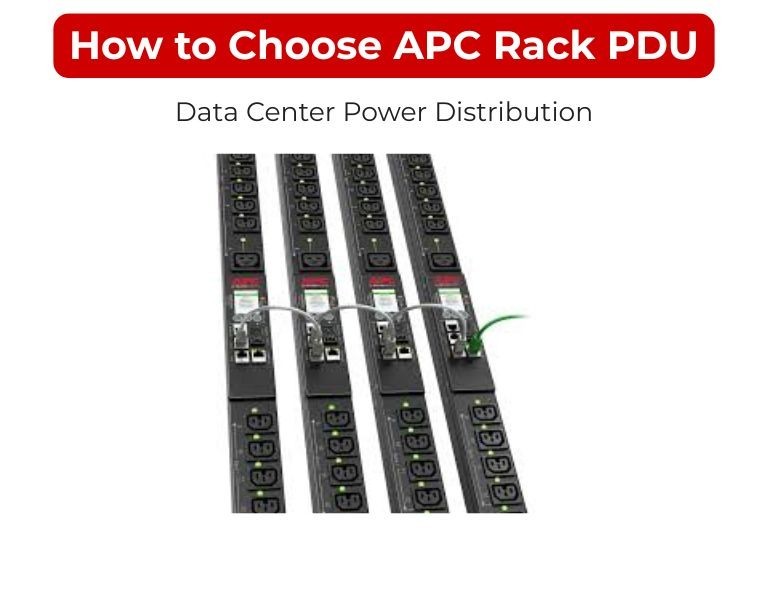
How to Choose APC Rack PDU for Data Center Power Distribution

Introduction (direct answer first)

Choose an APC rack PDU based on load capacity, monitoring level, and control requirements—not just outlet count.
Start with your rack’s power draw and redundancy design, then decide whether you need basic distribution, metering, or outlet-level control.

Use Case / Deployment Fit

Basic PDU (no monitoring)

  • Lab racks, non-critical environments
  • Stable loads with no need for visibility
  • Lowest cost option

Metered PDU (input-level monitoring)

  • Standard enterprise racks
  • Capacity planning and load balancing
  • Avoiding circuit overload

Switched PDU (remote outlet control)

  • Production environments
  • Remote reboot capability for servers/network gear
  • Power sequencing after outages

Metered-by-Outlet PDU (advanced visibility)

  • High-density racks
  • Colocation billing or per-device tracking
  • Detailed capacity optimization

Example: Models like AP8659 provide per-outlet metering and switching, enabling granular control and monitoring of each device.

Technical Breakdown

1. Power Capacity (Most Critical Decision)

  • Typical options: 16A, 32A, 3-phase
  • Voltage: 230V (common globally), 208V (US DCs)

Rule:
Calculate total rack load → add 20–30% headroom

Modern APC PDUs support up to ~17 kW per unit depending on configuration.

2. Input & Redundancy Design

  • Single-feed PDU → for non-redundant racks
  • Dual PDU (A/B feed) → for critical infrastructure

If you’re running dual PSUs per server, you need two PDUs per rack (A+B feeds).

3. Outlet Configuration (C13 vs C19)

  • C13 outlets → standard servers, switches
  • C19 outlets → high-power gear (blade servers, storage arrays)

Example: Enterprise PDUs often mix both (e.g., 21×C13 + 3×C19).

4. Monitoring Level

No monitoring

  • Cheapest
  • No visibility → higher operational risk

Input-level metering

  • Tracks total load
  • Helps prevent overload

Outlet-level metering

  • Tracks per-device consumption
  • Required for:
    • Chargeback environments
    • Capacity optimization

APC PDUs offer up to 1% metering accuracy, suitable for billing-grade measurements.

5. Switching Capability

Switched PDUs allow:

  • Remote reboot of locked devices
  • Power sequencing after outages
  • Load shedding control

This is critical for unmanned sites and remote data centers.

6. Form Factor

0U (vertical)

  • Most common in data centers
  • Saves rack space
  • Higher outlet density

1U/2U (horizontal)

  • Used in small racks or edge deployments

7. Network & Integration

Look for:

  • SNMP / Web interface
  • Integration with DCIM (e.g., EcoStruxure)
  • Alarm thresholds and alerts

Modern APC PDUs allow remote management, firmware updates, and multi-user access control.

Comparison Table

RequirementBasic PDUMetered PDUSwitched PDUMetered-by-Outlet
CostLowMediumMedium–HighHigh
MonitoringNoneTotal loadTotal loadPer outlet
Remote controlNoNoYesYes
Use caseNon-criticalStandard racksProduction ITHigh-density / colo
Risk visibilityNoneMediumHighMaximum

Limitations & Trade-offs

Basic PDUs

  • No visibility → risk of overload
  • No remote troubleshooting

Metered PDUs

  • Cannot isolate device-level issues

Switched PDUs

  • Higher cost
  • Requires network setup and access control

Metered-by-Outlet

  • Most expensive
  • Overkill for small deployments

Procurement Insight

The biggest mistake is under-specifying monitoring, not power capacity.

  • Lack of monitoring → reactive operations
  • Lack of switching → physical intervention required

Typical enterprise strategy:

  • Core racks → switched + metered-by-outlet
  • Standard racks → metered
  • Edge racks → basic or switched

Enterprise IT buyers often standardize on APC 8000/9000 series PDUs due to consistent firmware, network management, and rack compatibility—commonly sourced through distributors like DC Supplies for aligned rack deployments.

Real-world Scenarios

Scenario 1: Virtualized Rack (VM cluster)

  • Dual PDUs (A/B feed)
  • Switched + outlet-level metering

Scenario 2: Enterprise Network Rack

  • Metered PDU sufficient
  • No need for outlet-level control

Scenario 3: Colocation Rack (customer billing)

  • Metered-by-outlet mandatory

Scenario 4: Edge Site / Branch

  • Switched PDU for remote reboot
  • Avoids onsite intervention

Final Recommendation

  1. Start with total rack load + redundancy model
  2. Choose monitoring level based on operational visibility needs
  3. Add switching only if remote control is required

If unsure, default to:
0U switched, metered APC PDU with mixed C13/C19 outlets

It covers most enterprise use cases without limiting future scalability.
Comments (0)

No comment

Add a comment

You need to Login to add comments.

Close