No products
To be determined Shipping
$0.00 Total

Blog Categories
Archives
Latest Posts


A practical comparison between rack PDUs and basic power strips, focusing on safety, load handling, and data center deployment decisions.
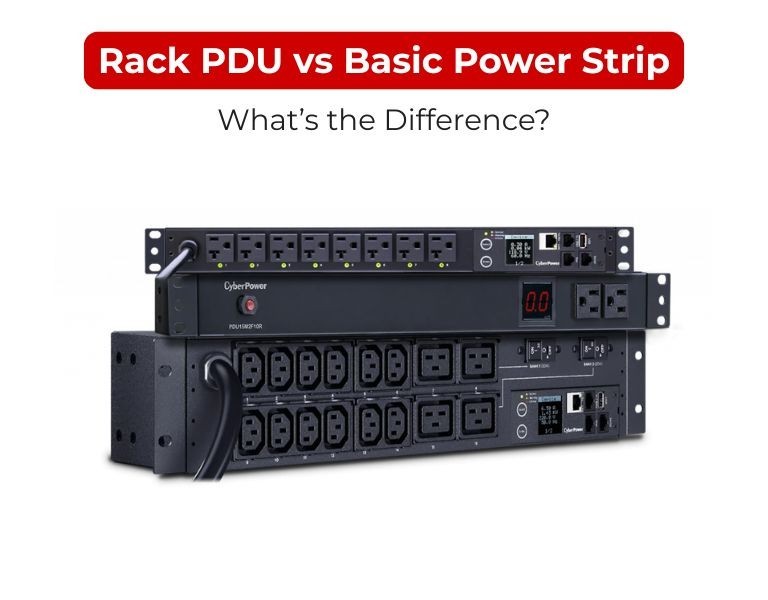
A rack PDU is designed for continuous, high-load IT environments with proper power distribution, monitoring, and safety controls.
A basic power strip is intended for low-load, non-critical use and lacks the reliability, protection, and scalability required in server racks.
Using a power strip in a data center rack is a risk—not a cost saving.
Rack PDU fits when:
Basic Power Strip fits when:
1. Load Capacity & Electrical Design
Impact: Power strips overheat under rack-level loads.
2. Reliability Under Continuous Load
Impact: Higher failure risk with power strips in IT racks.
3. Monitoring & Visibility
Impact: No way to track load or prevent overload with power strips.
4. Redundancy Support
Impact: Power strips cannot support enterprise uptime requirements.
5. Outlet Types & Compatibility
Impact: Compatibility and secure connections are limited with power strips.
6. Mounting & Form Factor
Impact: Poor cable management and airflow obstruction with power strips.
| Feature | Rack PDU | Basic Power Strip |
|---|---|---|
| Intended use | Data center / rack | Home / office |
| Load capacity | High (16A–32A+) | Low |
| Continuous operation | Yes | Not reliable |
| Monitoring | Available | None |
| Redundancy support | Yes | No |
| Mounting | Rack-integrated | Loose |
| Safety | High | Limited |
Rack PDU limitations:
Power Strip limitations:
The price difference is minor compared to the risk.
For any rack with servers, switches, or storage, a rack PDU is not optional—it is standard infrastructure.
Enterprise IT teams standardize on rack PDUs to ensure compatibility, safety compliance, and operational visibility, often sourcing through distributors like DC Supplies for consistent rack deployments.
Scenario 1: Server Rack Deployment
Rack PDU is mandatory. Power strips cannot handle sustained load or provide redundancy.
Scenario 2: Office Workstation Cluster
Power strip is acceptable if load is minimal and non-critical.
Scenario 3: Network Closet
Entry-level rack PDU recommended for safety and cable management.
Scenario 4: Temporary Lab Setup
Power strip can be used short-term, but not for production.
If there is any expectation of uptime, monitoring, or scalability, a rack PDU is the correct choice.










Comments (0)
No comment