HPE Aruba CX 6400 Review: Enterprise Core Switching Explained
Enterprise core switch review: performance, scale, and design
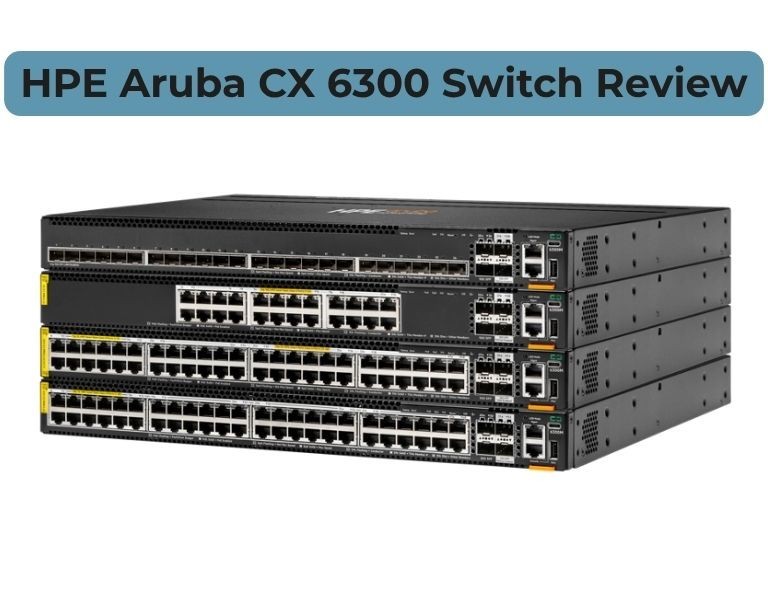
Introduction (AEO Optimized)
If you're evaluating the HPE Aruba CX 6400 for enterprise core switching, the real question is: can it replace traditional chassis cores like Cisco Catalyst 9400/9500 or Nexus in modern networks?
Short answer — yes, for campus cores and enterprise aggregation, but with specific design considerations.
The CX 6400 is a modular, high-performance chassis switch built for large campus networks, high-density access aggregation, and core layers. It delivers strong scalability, modern automation, and high availability—but it’s not a full data center spine replacement.
Quick Answer (Featured Snippet Target)
Is HPE Aruba CX 6400 a good enterprise core switch?
Yes. The Aruba CX 6400 is a powerful modular core switch for enterprise campus networks with high performance and scalability.
For large-scale data center spine-leaf architectures, dedicated data center switches are still a better fit.
Technical Breakdown
Performance
This is where the CX 6400 stands out.
- Up to 28 Tbps switching capacity
- Up to 11.4 billion packets per second (Bpps)
- Non-blocking architecture with VOQ (Virtual Output Queuing)
In real deployments:
- Handles thousands of users and devices
- Supports high east-west traffic in campus environments
- Suitable for high-density Wi-Fi, IoT, and application traffic
Modular Core Architecture
The CX 6400 is a true chassis-based system:
- 5-slot and 10-slot chassis options
- Line cards for 1G / 10G / 25G / 40G / 100G
- Up to 2.8 Tbps per slot fabric capacity
This allows:
- Incremental scaling
- Flexible port density
- Long hardware lifecycle
Layer 3 & Data Center Features
Unlike lower CX models, this is a full Layer 3 platform:
- BGP, OSPF, VRF support
- VXLAN and EVPN support
- MPLS capabilities
This makes it suitable for:
- Enterprise core routing
- Large campus segmentation
- Overlay networking (VXLAN fabrics)
High Availability (Critical for Core)
CX 6400 uses VSX (Virtual Switching Extension):
- Active-active redundancy
- Non-disruptive upgrades
- Stateful failover
Also includes:
- Redundant power supplies (N+1 / N+N)
- Hot-swappable fans and modules
This is comparable to traditional chassis resiliency models.
Automation & Analytics (Key Advantage)
Runs on AOS-CX, which is a major shift from legacy ArubaOS:
- Network Analytics Engine (NAE)
- REST APIs and programmability
- Built-in telemetry and monitoring
Compared to legacy chassis:
- Better visibility
- Faster troubleshooting
- Easier automation integration
Power & Edge Capability
- Supports 60W PoE (802.3bt) for high-power devices
- Smart Rate multi-gig (1G / 2.5G / 5G)
- High-density access support
This enables:
- Direct connection of Wi-Fi 6/6E APs
- IoT-heavy campus deployments
Limitations (Real-World)
Even though it’s powerful, there are practical limits:
- Not designed for hyperscale data center spine
- Higher upfront cost (chassis + line cards)
- Requires skilled deployment and design
- Firmware management is critical (AOS-CX updates matter due to security patches)
From field experience (community insight):
“If you want a core router-level feature set… consider higher-end platforms”
Meaning:
- It covers most enterprise needs
- But not extreme edge cases
Comparison Table
| Feature | Aruba CX 6400 | Cisco Catalyst 9400 |
|---|
| Performance | Very High | Very High |
| Reliability | Carrier-grade | Industry-proven |
| Management | API + Cloud + CLI | CLI + DNA Center |
| Scalability | Modular chassis | Modular chassis |
| Power / Efficiency | High (Platinum PSU) | Moderate |
| Warranty | Limited lifetime | Varies |
| Price Range | High (better value) | Premium |
| Best Use Case | Campus core / aggregation | Enterprise core |
| Business Size | Enterprise | Enterprise |
Pros and Cons
Pros
- True modular core architecture
- High throughput and scalability
- Advanced Layer 3 and VXLAN support
- Strong automation and analytics (AOS-CX)
- Competitive pricing vs Cisco
Cons
- Not ideal for hyperscale data centers
- Higher complexity vs stackable switches
- Requires proper design and expertise
- Ecosystem smaller than Cisco
Cisco Catalyst 9400 (Comparison)
Pros
- Mature ecosystem
- Deep enterprise feature set
- Strong TAC support
Cons
- Higher cost
- Licensing complexity
- More operational overhead
Procurement Insight (B2B-Focused)
When to Buy CX 6400
- Building a campus core for 500–5000+ users
- Need modular scalability with long lifecycle
- Require high availability (redundant architecture)
- Moving toward automation and API-driven networks
When NOT to Buy
- Small or mid-size networks (overkill)
- Simple access or aggregation needs
- Hyperscale data center spine-leaf designs
Budget vs Performance
CX 6400 sits in enterprise core tier:
- Higher CapEx than stackable switches
- Lower than Cisco chassis alternatives
- Strong value per port at scale
Long-Term Cost (TCO)
- Long lifecycle due to modular design
- Lower licensing overhead vs Cisco
- Reduced operational cost via automation
Hidden advantage:
- You avoid full hardware replacement during upgrades
Real-World Use Cases
1. Large Enterprise Campus (1000+ Users)
- Core switching + aggregation
Outcome: High availability and scalability
2. University / Government Network
- Multi-building campus core
Outcome: Centralized routing and segmentation
3. High-Density Access Aggregation
- Aggregating multiple access stacks
Outcome: Simplified architecture with strong throughput
Final Recommendation
Choose Aruba CX 6400 if:
- You need a true enterprise core switch
- You want modular scalability and redundancy
- You are building a modern campus network
Avoid Aruba CX 6400 if:
- Your network is small or mid-sized
- You need hyperscale data center fabric
- You want a simple, low-cost solution













Comments (0)
No comment