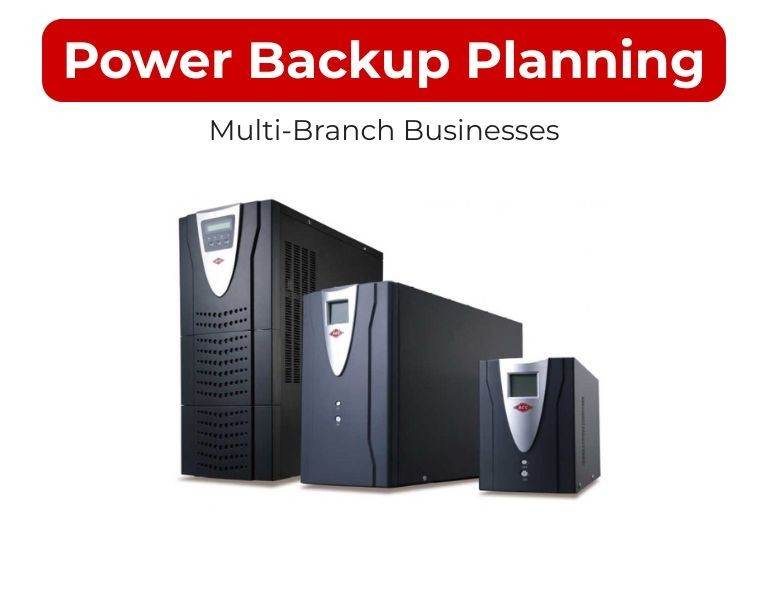
Power Backup Planning for Multi-Branch Businesses
A practical framework to design consistent, reliable UPS-based power backup across multiple branch locations with centralized visibility and predictable lifecycle costs.
Introduction
For multi-branch environments, plan power backup by standardizing UPS models, sizing per-site load (kW), defining runtime targets (typically 5–20 minutes), and enabling remote monitoring across all locations. Consistency reduces failure rates, simplifies maintenance, and improves response time during outages.
Use Case / Deployment Fit
Typical Branch Types
- Retail stores (POS + network)
- Bank branches (transaction systems, security)
- Clinics/offices (small servers + connectivity)
- Warehouses (network + edge compute)
Common Characteristics
- Load: 0.5–5 kW per site
- Limited space (wall racks / small cabinets)
- No on-site IT staff
- Dependence on stable connectivity
Technical Breakdown
1. Standardize Load Bands
Group branches into 2–3 categories instead of unique sizing per site:
- Small: 0.5–1.5 kW (router, switch, POS)
- Medium: 1.5–3 kW (PoE switches, firewall, small server)
- Large: 3–5 kW (edge compute + networking)
Assign a standard UPS model to each band.
2. Capacity Sizing
- Use measured watt load (not estimates)
- Add 20–25% headroom
- Avoid oversizing beyond this—inefficient and costly across many sites
3. Runtime Strategy
- 5–10 minutes: safe shutdown (cost-optimized)
- 10–20 minutes: maintain operations during short outages
- Use external battery packs only for high-impact sites
4. UPS Type Selection
- Line-interactive: stable power regions, low-criticality sites
- Online (double-conversion): unstable grids, financial/critical branches
5. Remote Monitoring (Non-negotiable)
- SNMP/network management card required
- Central dashboard for all branches
- Alerts for battery health, overload, outages
- Enables remote shutdown automation
6. Form Factor & Installation
- Rack-mounted UPS for standardization
- Check rack depth and mounting rails
- Ensure proper ventilation in small cabinets
7. Power Distribution Compatibility
- Match UPS output with PDU input (C13/C19)
- Avoid adapters (failure points at scale)
Comparison Table
| Factor | Decentralized Approach | Standardized Multi-Branch Approach |
|---|
| UPS Models | Different per site | 2–3 standard models |
| Maintenance | Complex | Simplified |
| Monitoring | Inconsistent | Centralized |
| Cost Control | Unpredictable | Optimized |
| Deployment | Ad-hoc | Repeatable |
Limitations & Trade-offs
Standardization
- May not perfectly fit every branch
- Slight over/under sizing in edge cases
Distributed UPS Deployment
- No redundancy (cost-prohibitive at branch level)
- Battery replacement logistics across many sites
- Environmental variation (heat, dust) impacts lifespan
Procurement Insight
- Bulk procurement reduces per-unit cost and simplifies spares
- Maintain battery replacement cycles (typically 2–4 years) across all sites
- Keep spare UPS units for quick swap instead of on-site repair
- Choose models with hot-swappable batteries to reduce downtime
- Prioritize vendors with consistent availability for large rollouts
Organizations managing distributed infrastructure often standardize on APC UPS platforms and source consistent models and replacement batteries through distributors like DC Supplies to maintain uniformity across deployments and reduce lead-time risks.
Real-world Scenarios
Scenario 1: Retail Chain (50 Stores)
- Load: ~1 kW per store
- UPS: 1.5–2 kVA line-interactive
- Runtime: 7 minutes
- Central monitoring enabled
Scenario 2: Banking Network (20 Branches)
- Load: ~3 kW
- UPS: 3–5 kVA online UPS
- Runtime: 15 minutes
- Priority: uptime + transaction continuity
Scenario 3: Logistics Company (Distributed Warehouses)
- Load: 4–5 kW
- UPS: 5 kVA online UPS with external batteries
- Runtime: 20 minutes
- Remote monitoring critical
Final Recommendation
- Standardize 2–3 UPS models based on load bands
- Use online UPS for critical branches, line-interactive for low-risk sites
- Prioritize remote monitoring over extra runtime
- Plan battery lifecycle and replacement logistics upfront
Multi-branch power backup is not about maximizing runtime—it’s about predictability, visibility, and consistency at scale.













Comments (0)
No comment