HPE Aruba CX vs Aruba 2930 What the Difference
Aruba CX vs 2930: platform, performance, and future roadmap
Introduction
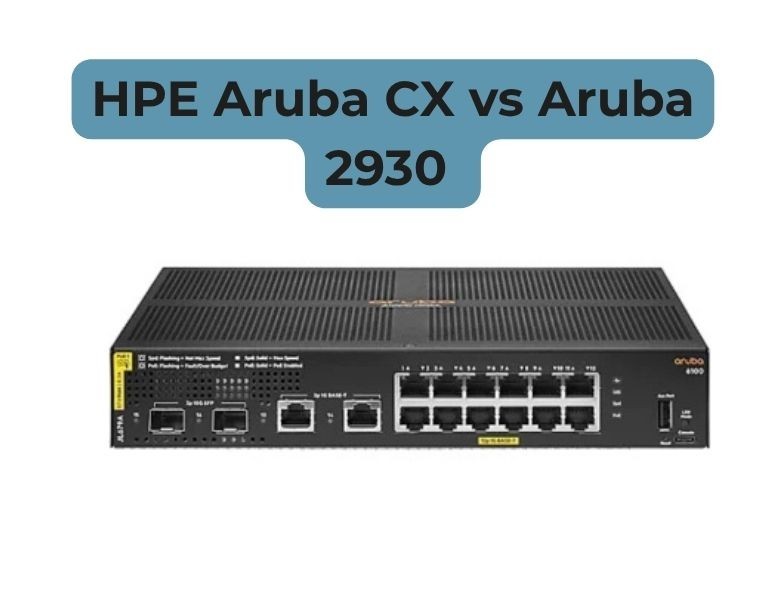
If you're comparing Aruba CX and Aruba 2930, the real difference is not hardware—it’s the operating system and long-term viability. CX is the current platform built on AOS-CX with automation and API support, while 2930 runs legacy ArubaOS-Switch. In practical deployments, CX is used for new networks and modernization, while 2930 is typically kept for existing environments where stability matters more than new features.
Which one should you choose?
Choose Aruba CX for any new deployment.
Choose Aruba 2930 only if you're maintaining or extending an existing ArubaOS network.
Technical Breakdown
Aruba CX Series (6000 / 6100 / 6200 and above)
- Runs AOS-CX (modern, database-driven OS)
- Built for automation (REST APIs, centralized management)
- Consistent OS across access, aggregation, and core
- Supports cloud, on-prem, and hybrid management
Deployment reality:
- Designed for modern enterprise and SMB networks
- Works better in environments with automation, VLAN scaling, and segmentation
- Entry models (like CX 6100) focus on Layer 2 with static routing
What actually matters:
- Same OS across all layers reduces operational complexity
- Better suited for Wi-Fi 6/6E environments and IoT scaling
- Long-term support and active development
Limitations:
- Learning curve if you're used to ArubaOS
- Entry-level CX models may lack advanced Layer 3
Aruba 2930 Series (2930F / 2930M)
- Runs ArubaOS-Switch (legacy platform)
- Full Layer 3 capabilities at access layer
- VSF stacking for scalability
Deployment reality:
- Widely used in campus access networks
- Stable and predictable in long-running environments
What actually matters:
- Familiar CLI for teams using older ProCurve/ArubaOS
- Strong Layer 3 at access layer compared to entry CX models
Limitations:
- No long-term innovation roadmap
- Limited automation and API support
- Gradual phase-out in favor of CX
Comparison Table
| Feature | Aruba CX Series | Aruba 2930 Series |
|---|
| Performance | Scalable (entry → core) | Strong at access |
| Reliability | Modern architecture | Proven stability |
| Management | AOS-CX (API, automation) | CLI-based (manual) |
| Scalability | High (VSF / VSX) | Medium (VSF) |
| Power / Efficiency | Optimized ASICs | Standard |
| Warranty | Limited lifetime | Limited lifetime |
| Price Range | $$–$$$ | $$ |
| Best Use Case | New deployments | Existing networks |
| Business Size | SMB → Enterprise | Mid → Enterprise |
Pros and Cons
Aruba CX
Pros
- Future-proof platform
- Automation and API support
- Unified OS across all network layers
Cons
- Higher upfront cost
- Requires retraining for teams used to ArubaOS
Aruba 2930
Pros
- Mature and stable
- Strong Layer 3 at access layer
- Familiar CLI
Cons
- Legacy OS
- Limited future support
- No modern automation capabilities
Procurement Insight
- Buy CX if you're building or refreshing infrastructure—this avoids migration costs later.
- 2930 is still valid if you already run ArubaOS across multiple sites and want consistency.
- If your team relies heavily on CLI and does not use automation, 2930 may still feel operationally simpler.
- However, from a lifecycle perspective, CX reduces long-term operational cost due to automation and centralized management.
If you're sourcing Aruba switches in the US, suppliers like DC Supplies typically carry both CX and 2930 inventory, which helps when you're transitioning gradually between platforms.
Real-World Use Cases
Office (25–50 users)
- CX 6000 or 6100
- Simple deployment with future scalability
Multi-branch business
- CX 6100 access + CX 6200 aggregation
- Centralized management across sites
Campus network (existing deployment)
- 2930 continues to operate reliably
- Upgrade path should plan for CX migration
Final Recommendation
Choose Aruba CX if you're deploying new infrastructure or planning long-term growth.
Choose Aruba 2930 only if you need compatibility with an existing ArubaOS-based network.
Avoid investing heavily in 2930 for new deployments—it creates a future migration requirement.












Comments (0)
No comment