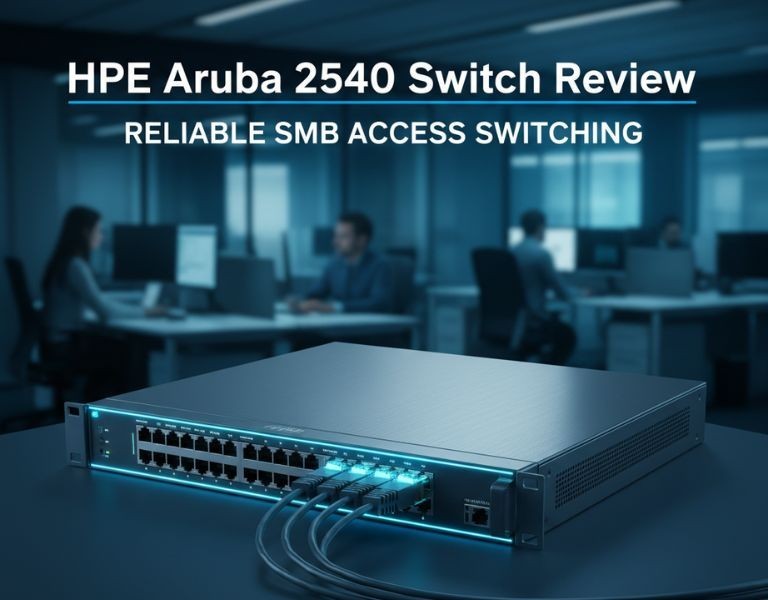
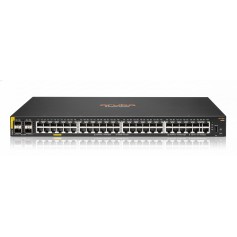
HPE Aruba 2540 Switch Review: Reliable SMB Access Switching
SMB access switch review: reliability vs modern alternatives
Introduction
If you're considering the HPE Aruba 2540 for SMB or branch access switching, the real question is: is it still reliable enough in modern networks, or outdated compared to CX series?
Short answer — it’s reliable, stable, and cost-effective, but no longer ideal for new deployments.
The Aruba 2540 delivers solid Layer 2 access switching with PoE, 10G uplinks, and simple management. However, it runs on older architecture and lacks modern automation and scalability features.
Quick Answer
Is HPE Aruba 2540 still good for SMB networks?
Yes, for stable and budget-friendly SMB access deployments.
No, for modern networks needing automation, scalability, and long-term lifecycle support.
Technical Breakdown
Performance
The Aruba 2540 is built on ProVision ASIC and delivers consistent edge performance.
- 128 Gbps switching capacity
- Up to ~95 Mpps throughput
- Sub-4 µs latency for Gigabit traffic
In real-world SMB deployments:
- Handles VoIP, Wi-Fi, and user traffic reliably
- No issues for standard office workloads
But:
- Limited headroom for high-density or future growth
Access Layer Capability
This is strictly an access-layer switch.
Best fit:
- SMB offices
- Branch deployments
- Edge connectivity
Supports:
- VLANs, ACLs, QoS
- Static and RIP routing only
Not designed for:
- Aggregation
- Core switching
- Advanced Layer 3 routing
PoE & Edge Device Support
- Up to 370W PoE+ budget
- Powers:
- Wi-Fi access points
- IP cameras
- VoIP phones
For SMB, this is sufficient.
For high-density Wi-Fi 6/6E, it starts to fall short.
Uplinks & Connectivity
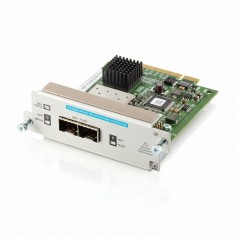
- 4 × 10G SFP+ uplinks
- 24 or 48 Gigabit access ports
This allows:
- Clean uplink to aggregation/core
- Small network scalability
Management & Operations
Supports:
- CLI (ArubaOS-Switch)
- Web GUI
- Aruba Central (cloud)
- SNMP management
Key point:
- Easy to deploy with Zero Touch Provisioning
But compared to CX:
- Limited automation
- No advanced telemetry
- Less visibility
Security & Network Control
- 802.1X authentication
- ACLs and traffic filtering
- Integration with Aruba ClearPass
Works well for:
- SMB security policies
- Basic network segmentation
Limitations (Important for Buyers)
- Legacy OS (ArubaOS-Switch)
- Limited Layer 3 (no OSPF/BGP)
- No modern analytics engine
- Not future-proof for long-term enterprise planning
Comparison Table
| Feature | Aruba 2540 | Aruba CX 6200 |
|---|
| Performance | Good | Higher |
| Reliability | Proven | Strong |
| Management | CLI + basic cloud | Cloud + API + automation |
| Scalability | Limited | Better stacking |
| Power / Efficiency | Moderate | Improved |
| Warranty | Limited lifetime | Limited lifetime |
| Price Range | Low | Mid-range |
| Best Use Case | SMB access | Modern access |
| Business Size | SMB | SMB to Enterprise |
Pros and Cons
Aruba 2540
Pros
- Proven long-term reliability
- Affordable (especially refurbished market)
- Simple deployment
- No licensing complexity
Cons
- Legacy platform
- Limited automation and visibility
- Not suitable for future-ready networks
- Limited Layer 3 capability
Aruba CX 6200 (Modern Alternative)
Pros
- Modern AOS-CX OS
- Better performance and scalability
- Automation and API-driven management
- Long-term support
Cons
- Higher upfront cost
- Requires transition from legacy CLI
Procurement Insight
When to Buy Aruba 2540
- Budget-constrained SMB deployments
- Expanding an existing ArubaOS-Switch network
- Short-term infrastructure needs
- Refurbished hardware strategy
When NOT to Buy
- New network build (2025+)
- High-density wireless environments
- Automation-first IT strategy
- Long-term infrastructure investment
Budget vs Performance
- Very strong on cost savings
- Limited on future scalability
Long-Term Cost (TCO)
Hidden risks:
- Higher operational effort (manual management)
- Earlier replacement cycle
- Limited upgrade path
Real-World Use Cases
1. Small Office (20–80 Users)
- Access switching with PoE
Outcome: Stable, cost-effective
2. Branch Office Deployment
- Minimal IT presence
Outcome: Easy deployment with centralized control
3. Budget-Constrained Rollout
- Refurbished or secondary market
Outcome: Good short-term ROI
Final Recommendation
Choose Aruba 2540 if:
- You need a low-cost, reliable access switch
- You are extending an existing Aruba environment
- Your network requirements are simple
Avoid Aruba 2540 if:
- You are building a new network in 2025
- You need automation and scalability
- You want long-term infrastructure value













Comments (0)
No comment