Close

Latest Posts

Single-Phase vs Three-Phase UPS: Which One Do You Need?
A practical comparison of single-phase and three-phase UPS systems based on load type, scalability, and deployment...
on Apr 29, 2026 | by Qaisar Khan
Signs Your APC UPS Battery Needs Replacement
Key indicators that your APC UPS battery is failing, with practical checks to confirm replacement timing and avoid...
on Apr 29, 2026 | by Justin
How to Identify the Right RBC Battery for Your UPS Model
A practical method to accurately identify the correct APC Replacement Battery Cartridge (RBC) using UPS model data,...
on Apr 29, 2026 | by Justin

Single-Phase vs Three-Phase UPS: Which One Do You Need?

Posted on: Apr 29, 2026 | Author: Qaisar Khan | Categories: UPS

A practical comparison of single-phase and three-phase UPS systems based on load type, scalability, and deployment requirements in IT environments.
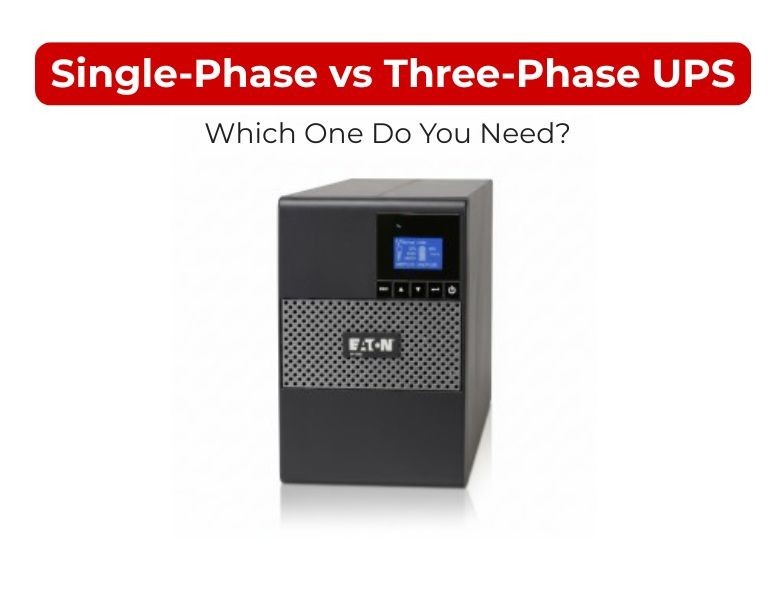
Single-Phase vs Three-Phase UPS: Which One Do You Need?

Introduction

Choose single-phase UPS for low to moderate loads (offices, small server rooms) and three-phase UPS for high-density, scalable, or data center environments.
The decision depends on total load, power distribution, and future expansion—not just current usage.
Incorrect selection leads to inefficiency, capacity limits, or infrastructure mismatch.

Use Case / Deployment Fit

Single-Phase UPS:

  • Small offices
  • Network closets
  • SMB server racks
  • Edge deployments

Three-Phase UPS:

  • Data centers
  • Industrial environments
  • Large server rooms
  • High-density racks

Use three-phase when load exceeds typical single-phase limits or when infrastructure already supports it.

Technical Breakdown

Power Input & Distribution

Single-Phase:

  • One live + one neutral
  • Typically 230V supply
  • Simple installation

Three-Phase:

  • Three live conductors
  • Higher power delivery efficiency
  • Balanced load across phases

Load Capacity

Single-Phase UPS:

  • Typically up to ~10 kVA
  • Suitable for localized loads

Three-Phase UPS:

  • Starts from ~10 kVA and scales upward
  • Supports large, centralized loads

Scalability

Single-Phase:

  • Limited scaling
  • Expansion requires additional standalone units

Three-Phase:

  • Modular scaling options
  • Easier to expand within same infrastructure

Efficiency & Performance

Single-Phase:

  • Efficient at lower loads
  • Simpler design

Three-Phase:

  • Better efficiency at higher loads
  • Reduced conductor size for same power delivery
  • Improved load balancing

Installation Complexity

Single-Phase:

  • Plug-and-play in many cases
  • Minimal electrical changes

Three-Phase:

  • Requires electrical planning
  • Professional installation
  • Distribution panel considerations

Comparison Table (if needed)

FeatureSingle-Phase UPSThree-Phase UPS
Typical CapacityUp to ~10 kVA10 kVA and above
DeploymentSMB / edgeEnterprise / data center
ScalabilityLimitedHigh
InstallationSimpleComplex
Efficiency at ScaleLowerHigher
Power DistributionSingle lineBalanced across phases

Limitations & Trade-offs

Single-Phase Limitations:

  • Not suitable for high-density loads
  • Difficult to scale efficiently
  • Can lead to uneven load distribution

Three-Phase Limitations:

  • Higher upfront cost
  • Requires compatible infrastructure
  • Overkill for small deployments

Procurement Insight

  • Calculate total load in watts before deciding
  • If load is approaching 8–10 kVA, evaluate three-phase early
  • Consider future expansion, not just current load
  • Align UPS type with building power infrastructure
  • Factor in installation and maintenance complexity

Organizations deploying UPS at scale often align procurement with infrastructure standards and source equipment through distributors like DC Supplies to maintain consistency across sites.

Real-world Scenarios

Scenario 1: Small Office Deployment

  • Load: 1.5 kW
  • Requirement: Short runtime for safe shutdown
  • Choice: Single-phase UPS

Scenario 2: Growing Server Room

  • Load: 7 kW, expected to grow
  • Decision: Evaluate transition to three-phase
  • Outcome: Avoid future redesign

Scenario 3: Data Center Rack Row

  • Load: 20 kW+
  • Requirement: Scalable and balanced power
  • Choice: Three-phase UPS

Final Recommendation

Use single-phase UPS for small, localized IT loads where simplicity and cost matter.
Choose three-phase UPS when dealing with high power demands, scalability requirements, or data center environments.
If growth is expected, planning for three-phase early avoids costly redesign later.
Comments (0)

No comment

Add a comment

You need to Login to add comments.

Close