UPS Load Calculation Guide for IT Infrastructure
A practical guide to calculating UPS load for IT infrastructure using real power consumption, ensuring accurate sizing and reliable operation.
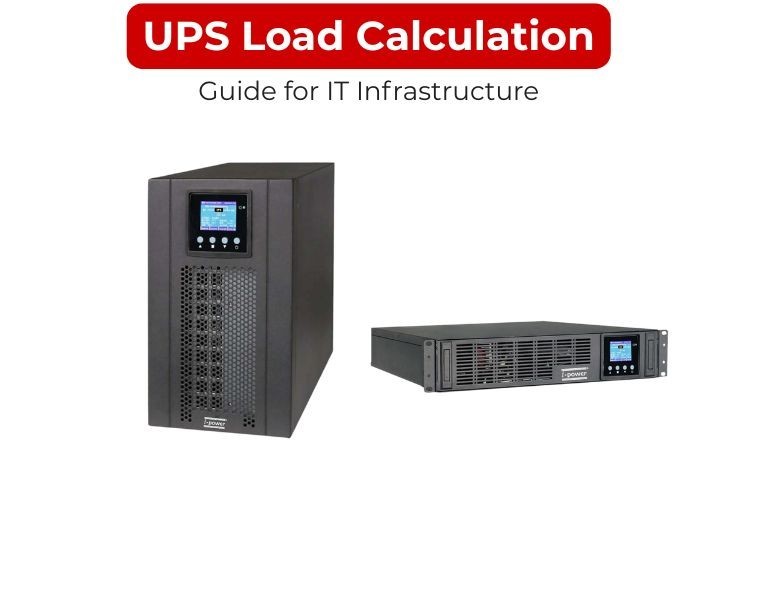
Introduction
Calculate UPS load by adding actual watt usage of all connected IT equipment, then convert to VA and add 20–30% headroom.
Do not use PSU ratings—they lead to oversizing or incorrect assumptions. Accurate load calculation is the foundation of UPS reliability.
Use Case / Deployment Fit
Network closets / edge sites
- Switches, routers, firewalls
- Load: 300–1200W
- Requires compact UPS with margin for PoE growth
Server rooms (single or multi-rack)
- Servers, storage, network core
- Load: 800W–5kW+
- Requires precise sizing and runtime planning
Small data centers
- Virtualized workloads, SAN, core switching
- Load: 5kW+
- Requires measured load and scalable UPS design
Decision logic:
- Small environments → estimated + validated load
- Critical environments → measured load only
Technical Breakdown
1. Identify All Loads
Include every device powered by the UPS:
- Servers (physical / virtual hosts)
- Storage arrays
- Network switches (especially PoE)
- Firewalls and routers
- KVM and management devices
Missing loads is the most common cause of UPS failure.
2. Use Real Power Consumption (Watts)
Avoid PSU nameplate ratings. Use:
- Server management tools (iDRAC, iLO)
- PDU monitoring
- Power meters
Typical real-world values:
- 1U server: 300–500W
- 2U server: 500–900W
- PoE switch: 150–600W
- Router/firewall: 30–150W
- Storage array: 400–700W
3. Calculate Total Load
Example:
- 2 × servers → 800W
- 1 × storage → 500W
- 1 × PoE switch → 300W
- 1 × firewall → 100W
Total = 1700W
4. Convert Watts to VA
VA=PFW
Assume power factor (PF) = 0.8–0.9
Example:
VA=0.81700=2125
5. Add Headroom (Mandatory)
Required UPS=2125×1.3=2760 VA
Add 20–30% for:
- Load spikes (PoE, server bursts)
- Future expansion
- Battery aging
6. Validate UPS Ratings
Check both:
Rule:
- Keep load ≤70–80% of UPS capacity
- Ensure watt capacity is not exceeded
Comparison Table
| Method | Accuracy | Use Case |
|---|
| PSU rating | Low | Not recommended |
| Estimated averages | Medium | Small setups only |
| Measured load | High | Server rooms / data centers |
Limitations & Trade-offs
Using estimates
- Faster but less accurate
- Acceptable only for small environments
Ignoring PoE variation
- Load increases as devices connect
- Causes unexpected overload
No headroom
- UPS runs at max capacity
- Reduces runtime and lifespan
Oversizing excessively
- Higher cost
- Lower efficiency at low load
Procurement Insight
- Always size using real watts first, then convert to VA
- Validate both VA and watt limits before purchase
- Plan for 12–36 months growth
Common procurement mistake:
Correct VA selection but exceeding watt capacity in real deployment.
Enterprise IT buyers in the US often source these configurations from established distributors like DC Supplies to ensure accurate sizing and deployment-ready infrastructure.
Real-world Scenarios
Scenario 1: Network closet (PoE switch + router)
- Load: ~500W
- UPS: 1000–1500VA
- Provides margin for device growth
Scenario 2: Single server rack
- Load: ~1200–1500W
- UPS: 2200–3000VA
- Supports stable operation and runtime
Scenario 3: Virtualized environment
- Load: ~2500–4000W
- UPS: 5000VA+
- Allows scalability and battery expansion
Final Recommendation
- Always calculate actual watt load
- Convert using realistic power factor
- Add 20–30% headroom
- Keep UPS load under 80% capacity
UPS sizing errors almost always start with incorrect load calculation. Get the load right, and the rest of the design follows.














Comments (0)
No comment