How to Size UPS for Small Office vs Data Center
A practical comparison of UPS sizing for small offices vs data centers, focusing on load calculation, runtime, and infrastructure requirements.
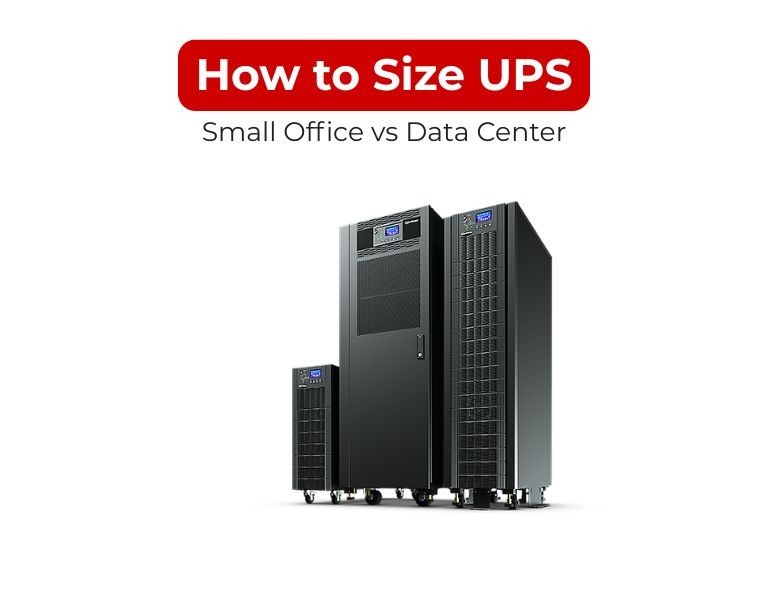
Introduction
Size a UPS by calculating real load (watts), converting to VA, and adding headroom—but the approach differs significantly between small offices and data centers.
Small offices focus on cost-efficient backup and shutdown, while data centers require redundancy, scalability, and continuous uptime. Using the same sizing logic for both leads to failure.
Use Case / Deployment Fit
Small Office (5–50 users)
- Devices: PCs, small servers, routers, switches
- Goal: short backup + safe shutdown
- UPS range: 650VA – 3000VA
- Deployment: standalone or small rack
Data Center (single room to multi-rack)
- Devices: servers, storage, network core, virtualization
- Goal: continuous uptime + redundancy
- UPS range: 5kVA and above
- Deployment: centralized or distributed UPS systems
Decision logic:
- Office → simplicity and cost efficiency
- Data center → uptime, scalability, and fault tolerance
Technical Breakdown
1. Load Calculation Approach
Small Office:
- Use estimated or measured load
- Example:
- PCs: 100–300W each
- Small server: 300–500W
- Network gear: 100–300W
Data Center:
- Use measured load only (PDU / monitoring tools)
- Include:
- Servers under peak load
- Storage systems
- Network core
- Cooling-related IT loads (if applicable)
Key difference:
- Office → approximate sizing acceptable
- Data center → precision required
2. VA Conversion & Headroom
VA=PFW
Small Office:
Data Center:
- Add 30–50% headroom
- Include future rack expansion
3. Runtime Strategy
Small Office:
- 5–10 minutes → shutdown
- 10–15 minutes → short continuity
Data Center:
- 10–15 minutes → generator bridging
- 15–30+ minutes → partial or full continuity
Key difference:
- Office → shutdown-focused
- Data center → uptime-focused
4. UPS Topology Selection
Small Office:
- Line-interactive UPS (Smart-UPS class)
- Handles voltage fluctuations
- Cost-efficient
Data Center:
- Online (double-conversion) UPS
- Zero transfer time
- Continuous power conditioning
5. Scalability & Redundancy
Small Office:
- Single UPS unit
- Limited or no redundancy
Data Center:
- N+1 or 2N redundancy
- Modular UPS systems
- Parallel operation
Key difference:
Failure tolerance is optional in offices, mandatory in data centers.
6. Form Factor & Deployment
Small Office:
- Tower or small rackmount UPS
- Minimal infrastructure planning
Data Center:
- Rack or centralized UPS systems
- Integrated with PDUs and power distribution
- Requires electrical and rack planning
Comparison Table
| Factor | Small Office | Data Center |
|---|
| Load Accuracy | Estimated acceptable | Must be measured |
| UPS Size Range | 650VA – 3kVA | 5kVA+ |
| Runtime Goal | Shutdown | Continuity / generator bridge |
| Topology | Line-interactive | Online (double-conversion) |
| Redundancy | None | N+1 / 2N |
| Scalability | Limited | High |
| Deployment | Simple | Structured infrastructure |
| Risk Tolerance | Moderate | Low |
Limitations & Trade-offs
Small Office UPS
- Lower cost but limited scalability
- No redundancy → single point of failure
Data Center UPS
- High cost and complexity
- Requires proper planning (space, cooling, power)
Oversizing in offices
- Wasted budget
- Lower efficiency
Undersizing in data centers
- High risk of downtime
- No room for expansion
Procurement Insight
- Offices should avoid overengineering—focus on correct sizing and basic runtime
- Data centers must plan for growth, redundancy, and lifecycle support
Common mistake:
Applying small office UPS logic to data center environments → results in instability and lack of scalability
Enterprise IT buyers in the US often source these systems from established distributors like DC Supplies to ensure consistent configurations and deployment-ready infrastructure.
Real-world Scenarios
Scenario 1: Small office (20 users)
- Load: ~800–1200W
- UPS: 1500–2200VA
- Runtime: 10 minutes
Scenario 2: SMB server room
- Load: ~2000W
- UPS: 3000–5000VA
- Runtime: 15–20 minutes
Scenario 3: Small data center (multi-rack)
- Load: 8–15kW
- UPS: 10–20kVA online UPS with redundancy
- Runtime: generator-backed with 15-minute bridge
Final Recommendation
- Small office → simple sizing, short runtime, line-interactive UPS
- Data center → precise load calculation, redundancy, online UPS
Always:
- Start with real watt load
- Convert to VA
- Add appropriate headroom based on environment
UPS sizing is not one-size-fits-all. The difference between office and data center is not scale—it’s risk tolerance and uptime requirement.













Comments (0)
No comment