Close

Latest Posts

How to Choose APC UPS Runtime Based on Business Load
A practical guide to selecting APC UPS runtime based on actual business load, outage tolerance, and operational...
on Apr 24, 2026 | by Justin
How to Choose APC UPS Capacity (VA vs Watt Guide for Buyers)
A buyer-focused guide to correctly sizing APC UPS capacity using VA vs Watt, with real-world load calculation and...
on Apr 24, 2026 | by Justin
How to Choose APC UPS for Network Closets and Edge Deployments
A practical guide to selecting APC UPS systems for network closets and edge sites, focused on load sizing, runtime,...
on Apr 24, 2026 | by Justin

How to Choose APC UPS Runtime Based on Business Load

Posted on: Apr 24, 2026 | Author: Justin | Categories: APC, UPS

A practical guide to selecting APC UPS runtime based on actual business load, outage tolerance, and operational requirements.
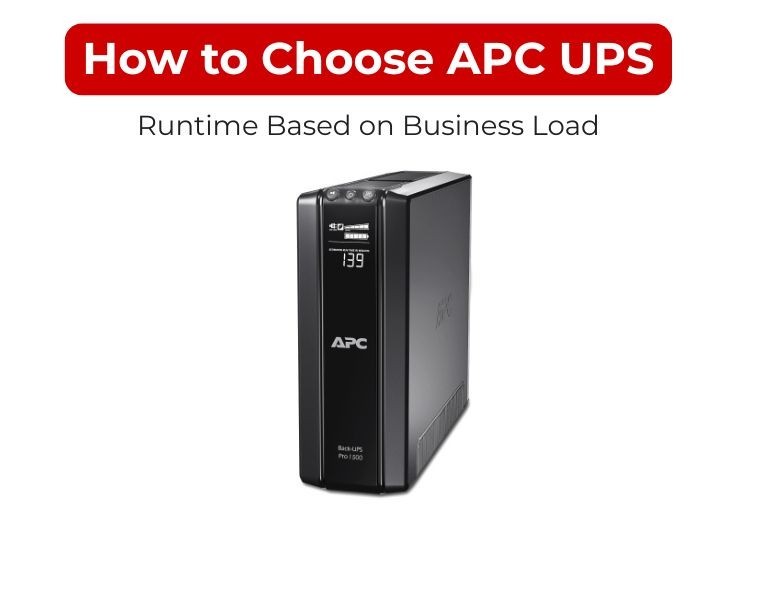
How to Choose APC UPS Runtime Based on Business Load

Introduction

Choose UPS runtime based on what your business needs to do during an outage, not just how long you want power.

Runtime is not a fixed number—it depends on load, shutdown requirements, and whether you need continuity or controlled shutdown. Most buyers overspend on capacity and underspec runtime.

Use Case / Deployment Fit

Basic IT environments (offices, small networks)

  • Goal: safe shutdown
  • Runtime: 5–10 minutes

Server rooms (SMB / edge infrastructure)

  • Goal: graceful shutdown or short continuity
  • Runtime: 10–20 minutes

Business-critical operations (retail, healthcare, edge sites)

  • Goal: maintain services during short outages
  • Runtime: 20–30 minutes

Generator-backed environments

  • Goal: bridge power until generator startup
  • Runtime: 10–15 minutes

Decision logic:

  • Shutdown only → short runtime
  • Keep systems running → extended runtime
  • No on-site staff → longer runtime + automation

Technical Breakdown

1. Runtime Depends on Load

Runtime decreases as load increases.

RuntimeBattery CapacityLoadRuntime propto frac{Battery Capacity}{Load}

  • Higher load → shorter runtime
  • Lower load → longer runtime

Example:

  • 1500VA UPS @ 50% load → ~15–20 minutes
  • Same UPS @ 90% load → ~5–7 minutes

This is why correct sizing directly impacts runtime.

2. Define Business Requirement First

Before selecting UPS, answer:

  • Do systems need to stay online or shut down?
  • Is there a generator?
  • Is the site staffed?
  • What is the cost of downtime per minute?

Common mistake:
Buying UPS based on VA only, ignoring operational requirement.

3. Runtime Tiers (Practical Benchmark)

RuntimeUse CaseTypical Setup
5–10 minGraceful shutdownSmall UPS, no expansion
10–20 minShort outage handlingStandard Smart-UPS
20–30 minBusiness continuityLarger UPS or light battery expansion
30+ minRemote / criticalExternal battery packs

4. Battery Scaling Strategy

Runtime is increased by:

  • Lowering load
  • Using higher capacity UPS
  • Adding external battery packs (EBM)

APC Smart-UPS SRT series supports battery expansion for predictable runtime scaling, which is critical in edge and branch deployments.

5. Runtime vs Capacity (Key Distinction)

  • Capacity (VA/W): how much load UPS can handle
  • Runtime (minutes): how long it can support that load

These are independent decisions.

Wrong approach:
“Higher VA = longer runtime”

Correct approach:
Match VA to load, then design runtime separately.

6. Software & Shutdown Control

Runtime planning must include:

  • Graceful shutdown timing
  • Load prioritization (critical vs non-critical)
  • Automated shutdown tools (e.g., PowerChute)

Without this, runtime is wasted or misused.

Comparison Table

Business RequirementRecommended RuntimeUPS Strategy
Desktop / basic IT5–10 minEntry Smart-UPS
Small server room10–15 min1500–3000VA Smart-UPS
Virtualized workloads15–25 minSmart-UPS + battery expansion
Remote edge site20–40 minSmart-UPS SRT + monitoring
Generator backup10–15 minBridge runtime only
High uptime environment30+ minOnline UPS + external batteries

Limitations & Trade-offs

Longer runtime

  • Higher cost (batteries are the main expense)
  • Increased space and weight
  • More heat generation

Short runtime

  • Risk of incomplete shutdown
  • No buffer for extended outages

Battery expansion

  • Improves runtime but adds complexity
  • Requires proper rack planning

Ignoring load variation

  • PoE switches and servers fluctuate
  • Runtime estimates may drop under peak load

Procurement Insight

  • Runtime is often underestimated during purchase
  • Battery cost can exceed UPS hardware in extended runtime setups
  • Always validate runtime using manufacturer runtime charts, not assumptions

A common procurement gap:

  • Correct UPS size
  • Insufficient runtime for real outage conditions

Enterprise IT buyers in the US often source these configurations from established distributors like DC Supplies to ensure correct battery sizing and rack compatibility.

Real-world Scenarios

Scenario 1: Small office server

  • Load: ~600W
  • Requirement: safe shutdown
  • Solution: 1000–1500VA UPS with ~10 min runtime

Scenario 2: Retail branch (no IT staff)

  • Load: ~800–1200W
  • Requirement: stay online during outages
  • Solution: 2200VA UPS with extended battery (~25 min runtime)

Scenario 3: Edge site with unstable power

  • Load: ~1500W
  • Requirement: continuous operation
  • Solution: Online UPS + external batteries (30+ min runtime)

Final Recommendation

  • Start with business requirement, not UPS specs
  • Match UPS capacity to load first
  • Then design runtime using battery strategy
  • For most environments:
    • 10–15 min = baseline
    • 20+ min = operational resilience

Runtime is not about maximum minutes—it’s about meeting operational objectives during power events.
Comments (0)

No comment

Add a comment

You need to Login to add comments.

Close