Close

Latest Posts

How to Choose APC UPS Runtime Based on Business Load
A practical guide to selecting APC UPS runtime based on actual business load, outage tolerance, and operational...
on Apr 24, 2026 | by Justin
How to Choose APC UPS Capacity (VA vs Watt Guide for Buyers)
A buyer-focused guide to correctly sizing APC UPS capacity using VA vs Watt, with real-world load calculation and...
on Apr 24, 2026 | by Justin
How to Choose APC UPS for Network Closets and Edge Deployments
A practical guide to selecting APC UPS systems for network closets and edge sites, focused on load sizing, runtime,...
on Apr 24, 2026 | by Justin

How to Choose APC UPS Capacity (VA vs Watt Guide for Buyers)

Posted on: Apr 24, 2026 | Author: Justin | Categories: APC, UPS

A buyer-focused guide to correctly sizing APC UPS capacity using VA vs Watt, with real-world load calculation and deployment logic.
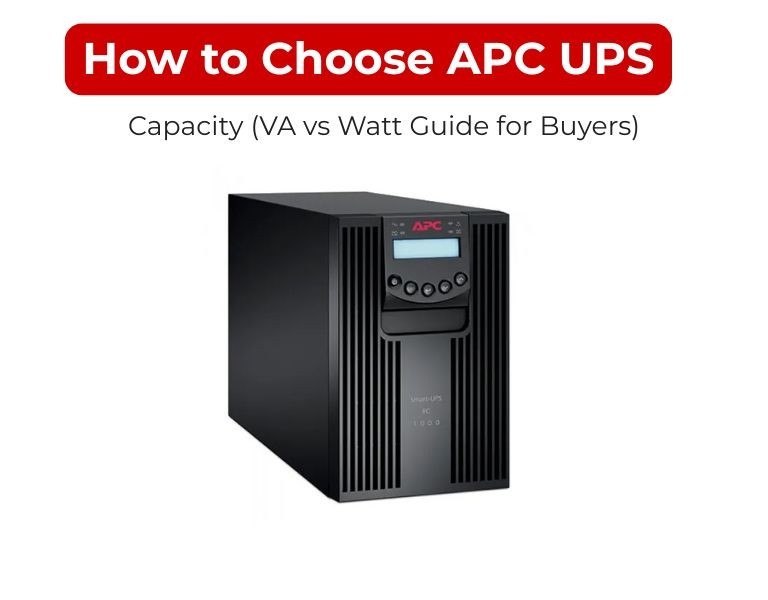
How to Choose APC UPS Capacity (VA vs Watt Guide for Buyers)

Introduction

Size an APC UPS using actual watt load first, then convert to VA and add 20–30% headroom.

VA is the UPS rating, but Watts is what your equipment actually consumes. If you size using VA alone, you risk overload or underutilization. Correct sizing starts with watts and ends with safe VA capacity.

Technical Breakdown

VA vs Watt (What Actually Matters)

VA=WPFVA = frac{W}{PF}

  • W (Watts): Real power consumed by equipment
  • VA (Volt-Amps): Apparent power supplied by UPS
  • PF (Power Factor): Efficiency ratio (typically 0.8–0.9 for IT loads)

Key takeaway:

  • UPS is rated in VA
  • Equipment load is measured in Watts
  • You must convert correctly to avoid undersizing

Step-by-Step Sizing Method

1. Calculate Total Load (Watts)
Add real consumption of all devices:

  • Servers
  • Switches (especially PoE)
  • Storage
  • Firewalls

Use actual measured load if available (not PSU ratings).

2. Convert Watts to VA

Example:

  • Load = 1200W
  • PF = 0.8

VA=12000.8=1500VA = frac{1200}{0.8} = 1500

3. Add Headroom (Critical Step)

Required UPS=1500×1.3=1950 VARequired UPS = 1500 times 1.3 = 1950 VA

  • Add 20–30% margin for:
    • Load spikes
    • Future expansion
    • Battery aging

Typical Load Mapping (Real-World)

EquipmentTypical Load
1U server300–500W
2U server500–900W
PoE switch150–600W
Router/firewall30–150W
Storage array400–700W

APC UPS Capacity Selection

Load (Watts)Recommended UPS
≤600W1000 VA
600–1000W1500 VA
1000–1600W2200 VA
1600–2500W3000 VA
2500W+5000 VA+

Rule: Never run a UPS at 100% load. Stay within 70–80% for reliability.

Use Case / Deployment Fit

Small office / network closet

  • Load: 300–800W
  • UPS: 1000–1500 VA

Single server rack

  • Load: 800–1500W
  • UPS: 1500–3000 VA

Virtualized environment / storage-heavy

  • Load: 1500–3000W
  • UPS: 3000–5000 VA

Edge site (remote)

  • Add extra margin for runtime and instability

Limitations & Trade-offs

Sizing too low

  • Overload shutdowns
  • Reduced battery life
  • No runtime buffer

Sizing too high

  • Higher cost
  • Lower efficiency at very low load

Ignoring power factor

  • Most common mistake
  • Leads to incorrect VA selection

Ignoring runtime

  • Capacity ≠ runtime
  • Battery determines backup duration

Procurement Insight

  • Always validate watt rating of the UPS, not just VA
  • Many APC models provide both ratings—use both in decision
  • Plan for 12–36 months growth, not current load

A typical mistake in procurement:

  • Matching VA rating
  • Ignoring watt capacity → causes overload in real deployment

Enterprise IT buyers in the US often source these systems from established distributors like DC Supplies for consistent availability and correctly specified rack configurations.

Real-world Scenarios

Scenario 1: Small rack (1 server + switch)

  • Load: ~700W
  • UPS: 1500 VA
  • Headroom allows future expansion

Scenario 2: PoE-heavy network closet

  • Load: ~1200W
  • UPS: 2200 VA
  • Handles spikes from device power draw

Scenario 3: Virtualized cluster

  • Load: ~2500W
  • UPS: 5000 VA
  • Allows runtime extension and stability

Final Recommendation

  • Always start with Watts, not VA
  • Convert using power factor
  • Add minimum 20–30% headroom
  • Keep load under 80% of UPS capacity

VA tells you what the UPS can supply.
Watts tell you what your equipment needs.

Correct sizing happens when both are aligned—not guessed.
Comments (0)

No comment

Add a comment

You need to Login to add comments.

Close