No products
To be determined Shipping
$0.00 Total

Blog Categories
Archives
Latest Posts

A technical guide to APC cooling — covering rack-mounted, in-row, and thermal management solutions to maximize data-center uptime and efficiency.
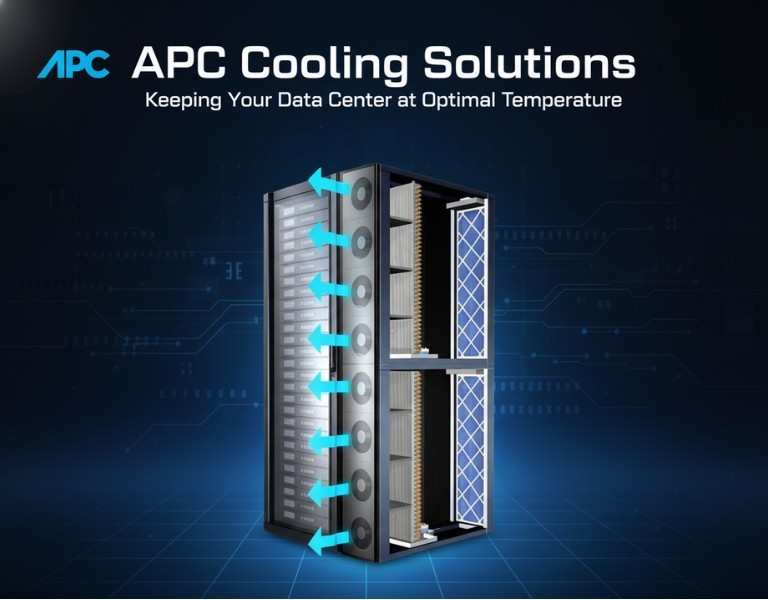
Picture this: your data center is running at 60–70% compute load, the room AC is fighting hotspots, and the inlet temperature on your most important rack keeps creeping upward. You know that cooling issues don’t just mean higher temps — they mean risk to uptime, throttled servers, and reduced hardware lifespan.
Choosing the right cooling strategy isn’t glamorous, but it affects everything from performance to long-term operating cost. This guide walks you through how APC’s cooling ecosystem works and helps you figure out which approach best fits your density, layout, and growth plans.
APC provides several cooling architectures designed for different densities and room layouts:
Room-based / Perimeter cooling — traditional CRAC/CRAH-style units that cool the entire space.
Rack-mounted cooling — small, contained cooling units built directly into or onto a rack.
In-Row cooling (air-cooled, chilled water, or direct expansion) — tightly coupled cooling placed between server racks for predictable airflow.
Full thermal-management ecosystems combining containment, sensors, humidity control, and DCIM monitoring.
Because heat loads vary dramatically between server rooms, edge sites, and high-density compute clusters, having these options allows cooling design that scales with demand.
| Product / Architecture | What It Does / Where It Fits |
|---|---|
| APC InRow RD 600 mm Air-Cooled Unit | Row-based cooling with directed front-to-back airflow. Strong choice for medium-to-high density racks and areas with humidity-control requirements. |
| APC InRow DX 300 mm 30 kW Unit | High-density, direct-expansion row cooling. Compact footprint with enough capacity for heavy compute, virtualization clusters, storage arrays, or GPU racks. |
| Rack-Mounted Cooling (Micro-Data-Center solutions) | Ideal for single-rack or two-rack deployments such as edge, retail, telecom, or remote sites with limited HVAC infrastructure. |
| InRow Chilled-Water or InRow RC Systems | Efficient for facilities with chilled-water plants. Scalable for medium or large data halls requiring predictable cooling and modular expansion. |
These cooling systems integrate with APC management tools (SNMP, network cards, environmental sensors, and DCIM platforms) to maintain stable inlet temps and warn operators before issues cause downtime.
Heat density rises faster than floor space. Modern racks often exceed 10–20 kW. Room AC alone can struggle to prevent recirculation and hotspots.
Stable inlet temperatures protect hardware. Close-coupled cooling avoids thermal swings and reduces the likelihood of thermal throttling or abnormal shutdowns.
Better airflow = better efficiency. In-Row cooling shortens the air path and stops mixing of hot and cold air, improving PUE and lowering operational costs.
Modular scalability. Instead of upgrading entire HVAC systems, you can add capacity per row or per rack as your IT load grows.
Low-density racks (≤ 5–7 kW).
Traditional server rooms using general-purpose HVAC.
Environments where whole-room humidity control is needed.
Small or remote IT spaces.
Edge computing, branch offices, or micro-data centers.
When reworking building HVAC is impractical or expensive.
Medium to high density (10 kW+ per rack).
Virtualization, storage-heavy, or GPU workloads.
Environments implementing hot-aisle or cold-aisle containment.
Growing, variable-load data centers.
Enterprise and colocation facilities focusing on energy efficiency.
Operators using DCIM platforms for proactive monitoring.
Aisle containment matters. In-Row systems work best when airflow paths are controlled.
Check electrical and mechanical requirements. Some systems require dual power feeds, refrigerant circuits, or chilled-water connections.
Plan for maintenance. Filter changes, sensor checks, and condensate monitoring must be scheduled.
Don’t overspend at low density. If racks are lightly loaded, room-based cooling may be more economical.
Enterprise virtualization cluster: Adding In-Row DX units ensures stable temps during fluctuating CPU-intensive workloads.
AI/GPU racks: High-density compute demands row-level cooling to avoid thermal throttling and maintain consistent performance.
Edge or telecom site: A single rack-mounted cooling unit maintains clean airflow without requiring major HVAC retrofits.
Colocation data hall: Deploying modular In-Row units on a per-row basis matches cooling to tenant consumption and keeps OPEX predictable.
APC cooling solutions cover everything from small rack deployments to high-density AI or storage clusters. The key is aligning cooling architecture with actual rack density, layout, and future expansion. With APC’s modular options — room-level, rack-level, and in-row — you can design cooling that improves uptime, lowers energy costs, and scales with real-world workloads.










Comments (0)
No comment