No products
To be determined Shipping
$0.00 Total

Blog Categories
Archives
Latest Posts


A factual look at Eaton’s power engineering background, industrial reliability, and why critical industries rely on it for long-term infrastructure stability.
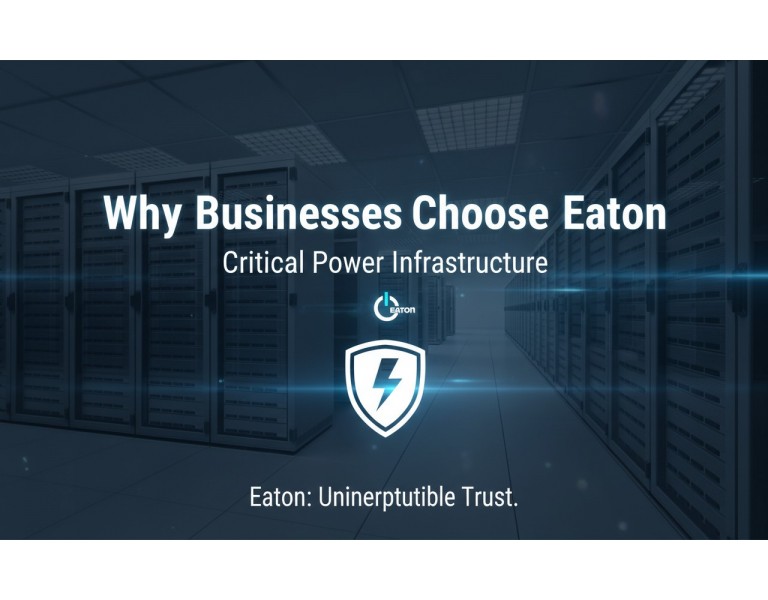
When businesses evaluate UPS systems and power infrastructure, the conversation usually shifts from price to risk.
If downtime costs thousands per minute — or compromises safety — the buying criteria changes. At that level, companies look for engineering depth, field history, and long-term serviceability.
Eaton is frequently selected in environments where power continuity is operationally critical, not just convenient. This article explains why — from an engineering and infrastructure perspective.
Eaton is not a company that started in IT accessories. Its roots are in industrial power management, electrical systems, and large-scale infrastructure.
Over decades, Eaton has developed:
Electrical distribution systems
Switchgear and breakers
Industrial automation controls
Power quality and backup systems
Data center power infrastructure
That broader electrical engineering foundation matters. It means UPS systems are designed within the context of complete power ecosystems — not as standalone devices.
In critical facilities, UPS units integrate with:
Power distribution units (PDUs)
Transfer switches
Generators
Monitoring platforms
Facility-level power management
This systems-level approach is one reason enterprises standardize on Eaton for long-term deployments.
In production environments, UPS performance isn’t judged by features — it’s judged by stability under stress.
Eaton’s online double-conversion UPS platforms are commonly engineered with:
High power factor output (often 0.9–1.0)
Robust internal bypass systems
Advanced thermal management
Hot-swappable battery modules (on many models)
Scalable runtime through external battery cabinets
Industrial reliability means:
Stable output voltage during grid fluctuations
Zero transfer time during outages
Tolerance to load variation
Consistent performance in 24/7 operation
In environments with fluctuating utility power, voltage sags, or harmonic distortion, consistent conditioning becomes more important than basic battery backup.
Eaton power systems are frequently deployed in industries where downtime has measurable consequences.
Hospitals and clinics rely on UPS systems for:
Imaging equipment
Electronic medical records
Lab systems
Nurse call systems
Edge IT rooms
In healthcare, power instability affects patient safety, not just productivity.
Manufacturing facilities depend on clean, continuous power for:
PLC controllers
Robotics
CNC equipment
Industrial servers
Production monitoring systems
Power interruptions can halt entire production lines and create significant financial loss.
Telecom infrastructure requires:
High-availability uptime
Remote monitoring
Scalable battery runtime
Edge-site reliability
In telecom environments, UPS systems often operate in distributed locations where service access must be predictable and modular.
In enterprise racks and data centers, Eaton systems are commonly used for:
Core switching
Storage arrays
Virtualization clusters
Edge computing nodes
These environments demand not only uptime but predictable power quality.
One major factor businesses consider is lifecycle support.
Critical infrastructure is not replaced every three years. UPS systems often remain in service for 7–10+ years with proper maintenance.
Key lifecycle considerations include:
Field-replaceable batteries
Modular service components
Firmware updates
Network monitoring integration
Service contracts and on-site support
Organizations often choose vendors with established service ecosystems to avoid unsupported hardware mid-lifecycle.
Long-term availability of parts and technical support reduces risk over time.
Beyond runtime, power quality matters.
In many facilities, utility power suffers from:
Voltage sags
Frequency variation
Transients
Harmonic distortion
Online UPS platforms from Eaton are engineered to isolate connected equipment from these disturbances through continuous double-conversion.
This protects:
Server power supplies
Storage controllers
Networking gear
Sensitive electronics
It’s not only about surviving outages — it’s about maintaining stable operation during imperfect grid conditions.
Businesses also value scalability.
Instead of replacing infrastructure when load grows, scalable UPS architectures allow:
Additional battery modules
Parallel capacity expansion
Rack-to-row scaling
Integration into larger electrical designs
In growing enterprises, the ability to expand without redesigning the entire power layer is significant.
Businesses don’t choose critical power vendors based on branding alone. They evaluate:
Engineering depth
Proven field deployment
Service network strength
Compatibility with broader electrical systems
Long-term cost of ownership
Eaton’s presence in industrial and enterprise electrical markets positions it as part of a larger infrastructure strategy rather than a standalone device vendor.
That context matters in board-level infrastructure planning.
Businesses choose Eaton for critical power infrastructure because of its industrial engineering foundation, reliability under continuous load, deployment across healthcare, manufacturing, telecom, and enterprise IT, and long-term service ecosystem. In environments where uptime directly impacts operations, infrastructure decisions prioritize durability, scalability, and lifecycle support over short-term cost.










Comments (0)
No comment