No products
To be determined Shipping
$0.00 Total

Blog Categories
Archives
Latest Posts


A practical, engineer-level guide to choosing the right Eaton UPS for your server room—focused on sizing, topology, and avoiding unnecessary costs.
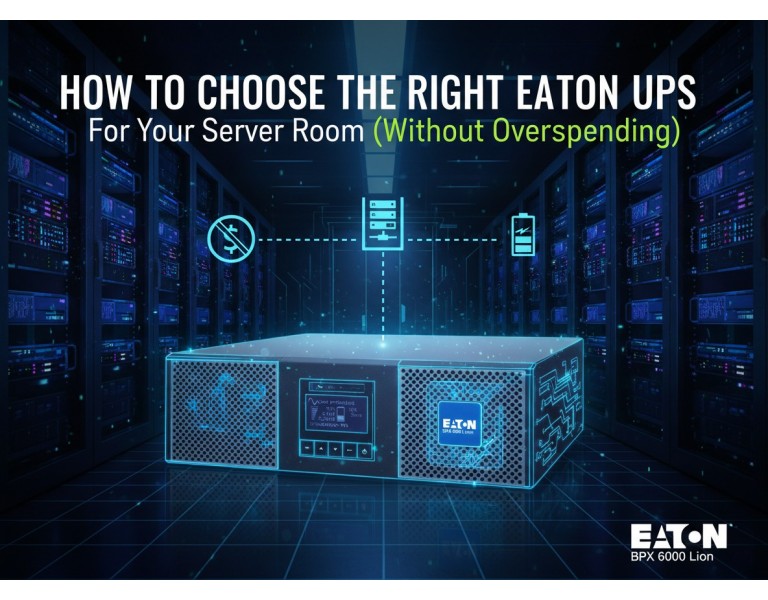
You’ve got a small server room or a dedicated rack—maybe a couple of servers, a firewall, and a core switch. Power cuts aren’t constant, but they’re frequent enough to cause unplanned shutdowns and corrupted systems. You know you need a UPS, but you don’t want to overspend on something designed for a data center when your setup doesn’t justify it.
This is where many IT teams go wrong with UPS selection—either buying too small and risking outages, or buying too much and wasting budget.
This guide focuses on how to choose the right Eaton UPS based on real workloads and environments, not on pushing specific models. The goal is to help you make a technically sound, cost-effective decision that will still hold up two or three years down the line.
A UPS isn’t just about keeping systems on during a blackout. In real environments, it affects:
Server uptime and data integrity
Hardware lifespan (clean power matters)
Recovery time after outages
Battery replacement and maintenance costs
Choosing the wrong UPS—especially the wrong topology—can quietly cost more over time than the initial price difference.
Eaton is widely used in enterprise IT environments because of its power quality, conservative ratings, and long-term support lifecycle. Their UPS portfolio spans:
Small server rooms and network closets
Enterprise racks and row-based deployments
Modular and scalable power protection
Eaton systems are generally designed with predictable performance and realistic load handling, which is why they’re common in production environments rather than lab-only setups.
One of the most common mistakes is sizing a UPS based on the maximum power rating written on the server power supply.
Measure real power draw (watts) using:
Server iDRAC / iLO
Smart PDUs
Power monitoring software
Add 20–30% headroom for:
Startup surges
Future expansion
Example:
If your rack consistently draws 1,200W, plan for a UPS that can comfortably handle 1,500–1,600W, not one rated “just enough” on paper.
This decision has more impact than most model comparisons.
Best for:
Small server rooms
Network closets
Offices with relatively stable power
Key traits:
Voltage regulation without constant battery use
Lower cost and higher efficiency
Limited isolation from severe power disturbances
Best for:
Critical servers
Unstable power environments
Virtualization hosts and storage systems
Key traits:
Continuous power conditioning
Zero transfer time
Higher cost and lower efficiency than line-interactive
Rule of thumb:
If your servers handle business-critical workloads or your building power quality is inconsistent, online UPS is worth the cost. Otherwise, line-interactive is often sufficient.
Long runtime sounds good, but it’s rarely necessary.
Ask yourself:
Do you have a generator?
Do you only need time for a clean shutdown?
Are outages usually under 15 minutes?
5–10 minutes: Enough for graceful shutdowns
15–30 minutes: Allows short outages to pass
Extended runtime: Only justified with generators or remote sites
Oversizing batteries is one of the easiest ways to overspend on a UPS system.
Even in small environments, UPS visibility matters.
Look for:
Network management cards (SNMP / web interface)
Integration with shutdown software
Alerting for battery health and overloads
Eaton UPS systems typically support centralized monitoring, which is especially useful if you manage multiple sites or racks.
Conservative and realistic power ratings
Strong performance in unstable power environments
Long product lifecycle and parts availability
Good integration with enterprise monitoring tools
Higher upfront cost than entry-level brands
Advanced models require proper configuration
Replacement batteries should be genuine to avoid issues
2 rack servers, firewall, core switch
Mostly cloud workloads, local authentication
Best fit:
Line-interactive Eaton UPS with 10–15 minutes runtime.
File server, NAS, 10G switching
Frequent power fluctuations
Best fit:
Online Eaton UPS for clean power and zero transfer time.
Current load is modest but expected to double
Best fit:
Online UPS with headroom rather than buying twice later.
UPS systems aren’t like generic accessories. Firmware updates, battery compatibility, and warranty support matter over the system’s life.
Buying through an authorized Eaton supplier ensures:
Valid manufacturer warranty
Genuine replacement batteries
Firmware and technical support access
This is why many IT teams prefer working with certified partners such as DC Supplies, especially for production environments where reliability matters more than short-term savings.
Don’t oversize blindly—measure real load first
Choose topology based on power quality, not marketing
Pay for runtime only if you actually need it
Invest in monitoring—it pays off during failures
If your server room runs mostly standard business services, a well-sized Eaton line-interactive UPS is often the smartest choice. For unstable power or critical workloads, Eaton’s online UPS systems provide long-term reliability that justifies the extra cost.
Choosing the right Eaton UPS isn’t about buying the biggest unit—it’s about matching load, topology, runtime, and environment correctly. When done right, you get stable power protection without overspending, and a system that supports your infrastructure instead of complicating it.










Comments (0)
No comment