No products
To be determined Shipping
$0.00 Total

Blog Categories
Archives
Latest Posts


A practical comparison of Netgear and HPE PoE switches for CCTV systems, focusing on power budget, heat handling, and long-term reliability.
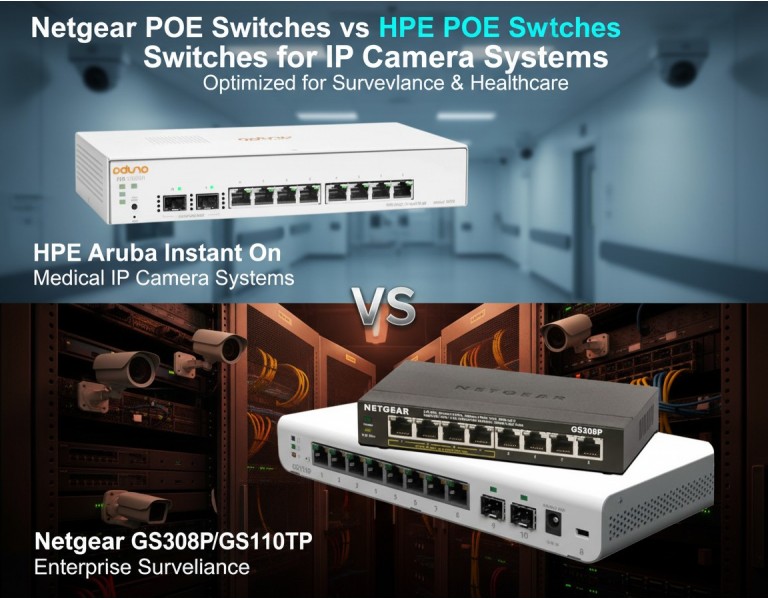
You’ve designed a CCTV layout with 16 or 32 IP cameras, calculated the PoE load, and everything looks fine on paper. Then the system goes live. A few cameras randomly reboot at night, the rack feels hotter than expected, or the switch fan never seems to slow down. For CCTV integrators, PoE switching isn’t just about port count — it’s about stable power delivery, thermal behavior, and uptime over years, not months.
This comparison looks at Netgear and HPE PoE switches specifically through the lens of IP camera deployments. The goal isn’t to push a brand, but to help you choose the right platform based on camera density, environment, and operational expectations.
Netgear is well known in the SMB and installer market. Their PoE switches are commonly used in small to mid-size camera systems where ease of setup, compact size, and competitive pricing matter.
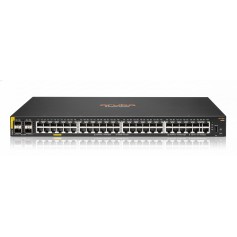
HPE targets enterprise and industrial-grade networks. Their PoE switches are designed for continuous operation, higher power stability, and environments where downtime or power fluctuation directly impacts operations.
| Criteria | Netgear PoE Switches | HPE PoE Switches |
|---|---|---|
| Performance | Stable PoE for small to mid camera counts | Consistent PoE under full load |
| Reliability | Good for controlled environments | Built for 24/7 critical uptime |
| Management | Web-based, simple configuration | Advanced CLI and web management |
| Power Efficiency | Adequate for typical SMB loads | Optimized power allocation |
| Warranty & Support | Limited to extended coverage models | Long-term enterprise support |
| Price Range | Lower upfront cost | Higher initial investment |
| Best Use Case | SMB CCTV installations | Large or mission-critical CCTV |
| Target Business Size | Small to mid-size deployments | Mid-size to enterprise |
Pros
Lower upfront cost for multi-camera setups
Simple web interface for quick deployment
Compact designs fit small racks or wall cabinets
Cons
Limited PoE headroom when fully populated
Thermal management can be challenging in hot rooms
Less tolerant of unstable power environments
Pros
Strong PoE budget stability across all ports
Better heat dissipation for dense camera loads
Designed for long-term continuous operation
Cons
Higher purchase cost
Requires networking knowledge for full feature use
Overkill for very small CCTV systems
If you’re installing CCTV in small offices, retail stores, or residential buildings with under 24 cameras, Netgear PoE switches usually make sense. They’re cost-effective, easy to configure, and handle standard IP cameras without issue.
If you’re powering high-wattage cameras, PTZ units, or running 24/7 surveillance in factories, campuses, or outdoor enclosures, HPE is the safer choice. You pay more upfront, but you gain thermal stability and predictable PoE behavior over time. The key is not overspending where you don’t need enterprise-grade resilience.
A 20-camera retail store needs silent operation and simple management in a small network cabinet.
A warehouse runs 48 PoE cameras, including PTZ models, in a hot control room with no downtime tolerance.
A multi-building campus needs consistent PoE delivery over long cable runs and centralized monitoring.
Choosing between Netgear and HPE PoE switches for IP cameras depends on scale, heat, and uptime requirements. Netgear fits smaller, cost-sensitive CCTV projects, while HPE delivers stability for demanding, always-on surveillance systems. Match the switch to the environment, not just the camera count.
DC Supplies works closely with CCTV integrators and IT teams to size PoE switches correctly for real-world camera loads. From calculating total wattage and future expansion to selecting switches that can handle heat and continuous operation, our team helps avoid costly mistakes after installation. Whether you’re deploying a small retail system or a multi-site surveillance network, DC Supplies provides practical guidance, reliable hardware options, and deployment-focused support to keep your CCTV infrastructure stable and scalable.










Comments (0)
No comment