No products
To be determined Shipping
$0.00 Total

Blog Categories
Archives
Latest Posts

A practical guide to choosing between line-interactive and online UPS systems for real SMB workloads, with clear Eaton model breakdowns.
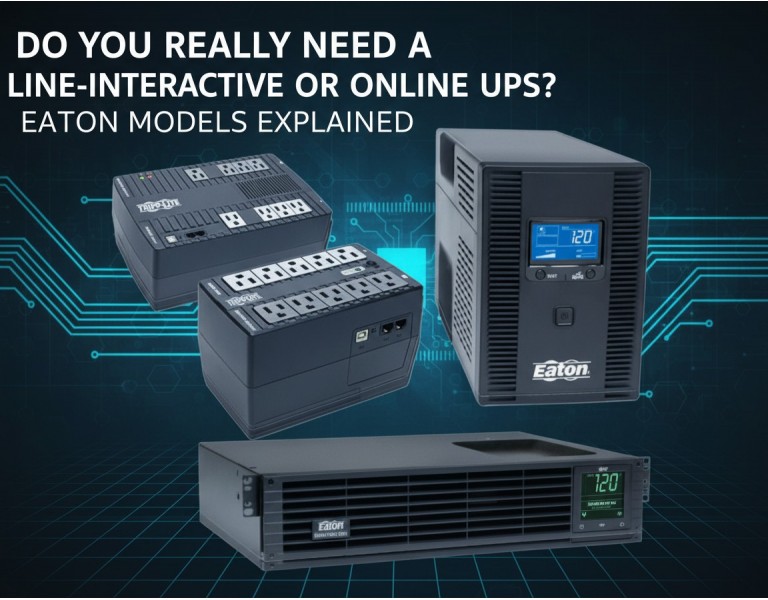
Most small businesses only think about power issues after they’ve already lost a server, corrupted a database, or had a firewall reboot in the middle of the workday. The confusing part is deciding whether a line-interactive UPS is “good enough” or if an online double-conversion unit is worth the extra cost. Both protect equipment, but they solve different problems — brownouts, voltage swings, generator transitions, and sensitive loads each behave differently. This guide breaks down the differences in a real, practical way and shows which Eaton models fit which type of business scenario, without pushing you toward unnecessary hardware.
Best for environments where the power is mostly stable but occasionally dips or spikes. Voltage regulation is handled without switching to battery every time.
Designed for places where voltage fluctuates all day, or where critical systems can’t tolerate even a millisecond of transfer time. Power is continuously cleaned and regenerated.
Eaton has two main UPS families relevant to SMBs:
Eaton 5-Series (5E, 5SC, 5P): Line-interactive units designed for offices, edge devices, and small server rooms.
Eaton 9-Series (9SX, 9PX): Online UPS systems built for mission-critical loads, servers, VoIP, and unstable utility regions.
Both options are known for strong voltage regulation, good battery management, and long-term reliability.
| Category | Line-Interactive (Eaton 5SC/5P) | Online (Eaton 9SX/9PX) |
|---|---|---|
| Performance | Protects against sags/spikes | Full isolation, clean regenerated power |
| Reliability | Minor transfer time | Zero transfer time |
| Management | Basic to advanced (model dependent) | Advanced LCD, full monitoring |
| Power Efficiency | Higher efficiency, lower heat | Lower efficiency due to double-conversion |
| Warranty & Support | Standard 2–3 years | Extended options available |
| Price Range | Budget-friendly | Higher investment |
| Best Use Case | Offices, edge devices, small server rooms | Critical servers, hospitals, unstable grids |
| Target Business Size | Small to mid-size | Mid-size to enterprise |
Pros
Lower upfront cost
Good AVR performance without frequent battery use
Smaller footprint and quieter operation
Suitable for desktops, switches, and small servers
Cons
Has transfer time during switchover
Not ideal for heavy voltage instability
Less suitable for high-sensitivity equipment
Pros
Zero transfer time
Full voltage and frequency regulation
Reliable for sensitive or high-load servers
Ideal for generator environments
Cons
Higher purchase cost
Generates more heat due to double-conversion
Requires more space and airflow management
If your office runs a few servers, VoIP phones, and network gear and the utility power is generally stable, a line-interactive Eaton 5SC or 5P is perfectly adequate. You’ll save money without compromising protection.
But if you're in a region with frequent voltage drops, noisy generator transitions, or you support on-prem apps where uptime matters, the 9SX or 9PX is the safer long-term investment. Critical loads like firewalls, database servers, and storage arrays benefit heavily from the clean output of an online UPS.
25-User Accounting Firm: Mostly cloud-based tools, one small server, and a firewall. A line-interactive 5P keeps systems stable without overspending.
Design Studio with Large File Transfers: On-prem NAS and high-load workstations benefit from the cleaner power of a 9SX, especially during generator runs.
Campus with Distributed IT Rooms: Mixed equipment across multiple buildings. Online 9PX units ensure consistent protection in areas with unstable voltage.
A line-interactive UPS is the right choice for most small businesses with stable utility power and modest server needs. Online UPS systems are worth the investment when uptime is critical, voltage is inconsistent, or sensitive equipment demands clean power. The key is matching the UPS type to the real conditions of your environment.
Keep your critical systems protected with the right Eaton UPS for your business. Whether you’re supporting basic network gear or running virtualized servers that can’t afford downtime, DC Supplies can help you choose the model that fits your workload, budget, and growth plans. Get expert guidance, fast availability, and reliable support so your infrastructure stays online when it matters most.










Comments (0)
No comment