No products
To be determined Shipping
$0.00 Total

Blog Categories
Archives
Latest Posts

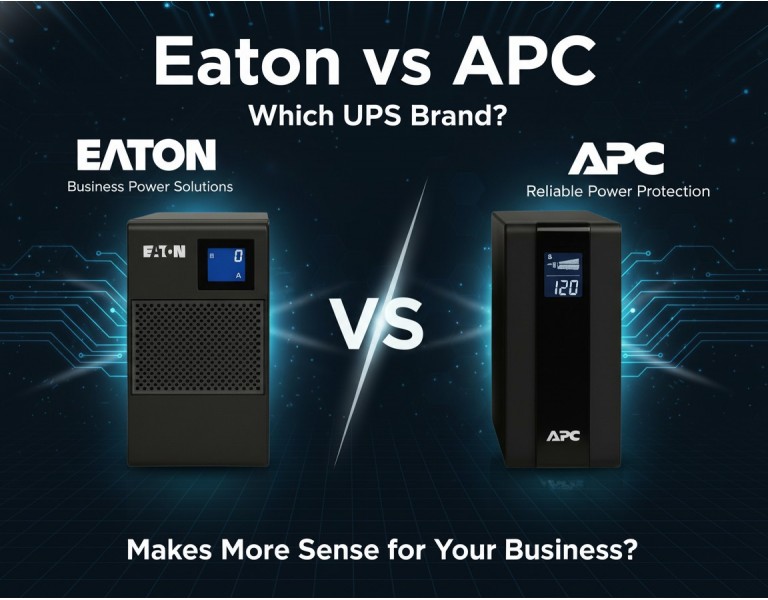
Most businesses only look at UPS capacity and price, but the real differences show up during voltage swings, unexpected outages, or when a battery fails at the wrong time. Eaton and APC are the two most common UPS brands you’ll see in server rooms, branches, and network closets, but they’re optimized for slightly different priorities. This guide breaks down how each behaves in real environments so you can choose the unit that fits your workload, not someone’s sales pitch.
Eaton focuses on electrical performance, high-efficiency designs, and strong power conditioning. Their line-interactive and online units are popular in SMB and mid-market deployments because of reliability, long battery life, and solid monitoring options.
APC is known for broad product availability, simple deployment, and user-friendly management. They dominate office and branch environments and offer a wide range of capacities with predictable performance and long-standing industry trust.
| Category | Eaton | APC |
|---|---|---|
| Performance | Strong AVR, high efficiency, robust internal components | Stable output, wide model range, consistent runtime |
| Reliability | Strong power conditioning, long battery lifespan | Proven track record, dependable for mixed workloads |
| Management | Advanced monitoring, hot-swap options | Easy-to-use tools, broad ecosystem support |
| Power Efficiency | Typically higher efficiency ratings | Good efficiency across most lines |
| Warranty & Support | 2–3 years depending on model | 2–3 years depending on model |
| Price Range | Generally mid-range | Mid-to-high depending on series |
| Best Use Case | Servers, storage, network racks | Offices, branches, mixed IT environments |
| Target Business Size | SMB–Mid-Market | Micro–Enterprise |
Pros
Strong voltage regulation and efficiency
Long-lasting batteries on many models
Good fit for virtualization hosts and NAS units
Hot-swap support on higher-tier units
Cons
Some models cost slightly more
Interface can be more technical
Fewer low-end units compared to APC
Pros
Wide product selection
Simple deployment and management
Strong ecosystem compatibility
Good value for general office loads
Cons
Some models run warmer
Batteries may need replacement sooner
Certain features locked behind accessories
If your environment runs servers, storage appliances, or anything sensitive to voltage fluctuations, Eaton generally provides better electrical performance and efficiency. For offices with mixed devices, branch setups, or locations where simplicity and wide availability matter, APC often fits better.
If your workload is mostly network gear and light compute, either brand works—pick based on price and size. For heavier VM or NAS workloads, Eaton usually offers stronger long-term value.
1. Small Office with Switches and ISP Gear
APC is usually the easier drop-in option with predictable runtime and simple management.
2. SMB Server Room Running ESXi or Hyper-V
Eaton’s stronger AVR and efficiency help stabilize heavier loads.
3. Distributed Retail Branches
APC fits well where easy replacements and broad availability matter.
Both Eaton and APC deliver solid protection, but they’re optimized for different needs. Eaton leans toward performance and efficiency, while APC excels in simplicity and broad availability. Choose based on workload sensitivity, runtime expectations, and the level of monitoring your environment requires.










Comments (0)
No comment