No products
To be determined Shipping
$0.00 Total

Blog Categories
Archives
Latest Posts

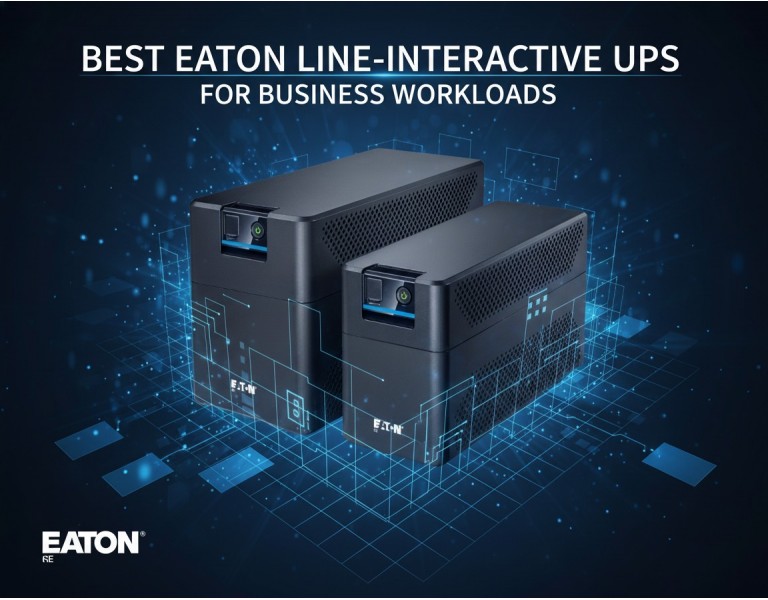
Power issues in small and mid-size offices usually show up as random reboots, corrupted files, failing switches, or a server that refuses to come back online after an outage. A line-interactive UPS is often the simplest way to stabilize voltage swings and keep critical equipment running long enough to shut down safely. But Eaton offers multiple models—5SC, 5P, and 5PX—and each fits a different type of workload. This guide breaks down which unit is the right match for your environment, based on real needs rather than spec-sheet marketing.
Eaton’s line-interactive family is designed for edge compute, branch offices, IDF closets, and small server deployments where voltage regulation matters but full double-conversion isn’t required.
Eaton 5SC: Entry-level line-interactive for small network gear and desktops.
Eaton 5P: Mid-range model with better efficiency, LCD monitoring, and load segmentation.
Eaton 5PX: Higher-capacity solution for servers, storage appliances, and small virtualization clusters.
| Feature | Eaton 5SC | Eaton 5P | Eaton 5PX |
|---|---|---|---|
| Performance | 500–1500 VA | 750–3000 VA | 1000–3000 VA (higher runtime options) |
| Reliability | Basic AVR | Enhanced AVR, better components | Highest in line-interactive range |
| Management | USB, basic monitoring | LCD, network card optional | Full monitoring, hot-swap batteries |
| Power Efficiency | Standard | High-efficiency ECO mode | Highest efficiency within series |
| Warranty & Support | 2–3 years | 3 years | 3 years |
| Price Range | Low | Mid | Mid-to-high |
| Best Use Case | Modems, switches, routers | Small servers, IDF racks | Virtualization hosts, NAS/SAN |
| Target Business Size | Micro–SMB | SMB | SMB–Mid-Market |
Pros
Simple installation and low cost
Good for protecting network gear
Compact sizes for tight spaces
Cons
Limited capacity for server workloads
Fewer monitoring options
Shorter runtime compared to 5P/5PX
Pros
Better AVR and efficiency
LCD with detailed load/battery stats
Optional network management card support
Good fit for 1–2 small servers
Cons
Still limited for heavier virtualization
Runtime varies by model
Slightly higher cost than entry-level units
Pros
Higher VA and extended battery options
Hot-swap batteries without downtime
Strong monitoring and control
Suitable for storage appliances and ESXi/Hyper-V hosts
Cons
Larger physical footprint
Higher price
More features than very small offices need
For typical small offices running switches, routers, and maybe a single on-premises application, the 5P strikes the best balance—good runtime, clean monitoring, and reasonable cost.
If you're protecting a small virtualization cluster, NAS/SAN, or anything that can’t go down during voltage fluctuations, the 5PX is the safer long-term option.
For lightweight loads (firewalls, access points, ISP gear), the 5SC is usually enough and avoids overspending.
1. 25-User Office with a Single Server
One Windows or Linux server plus a PoE switch typically runs well on a 1500–2200 VA 5P, offering enough runtime for graceful shutdowns and stable AVR.
2. Design Studio or Engineering Team with a NAS
Large file transfers and heavier storage I/O benefit from a 5PX with extended battery modules to avoid mid-work interruptions.
3. Remote Branch or Retail Location
A firewall, switch, and POS machine can be protected with a compact 5SC, reducing downtime from voltage dips or short outages.
Eaton’s line-interactive lineup covers everything from basic network protection to small-scale server and storage environments. Choosing the right model depends on your load, runtime expectations, and how much monitoring you need. The 5SC suits lightweight gear, the 5P fits most SMB server rooms, and the 5PX delivers the headroom required for more demanding workloads.










Comments (0)
No comment