No products
To be determined Shipping
$0.00 Total

Blog Categories
Archives
Latest Posts

Deep technical overview of APC rack PDUs—how remote monitoring, outlet control, and environmental sensing work and when each PDU type is the right choice.
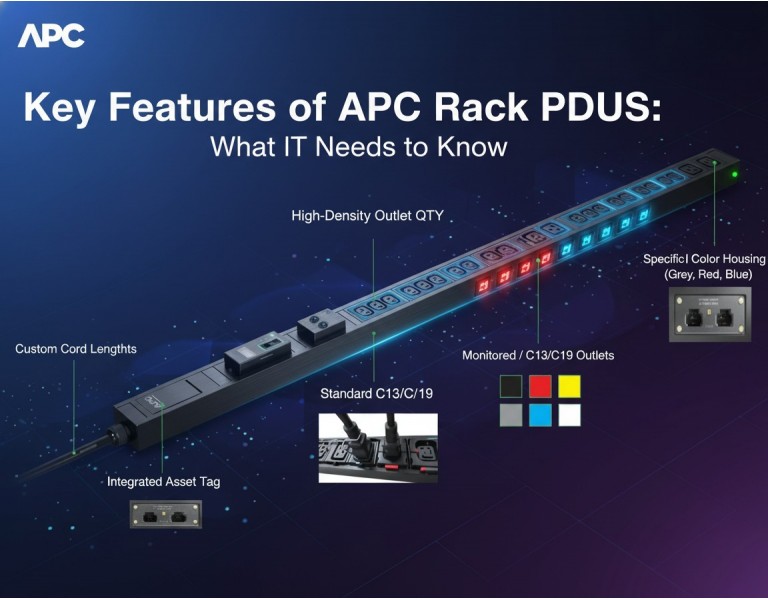
If you’re managing racks, the PDU is no longer “just a power strip.” APC’s rack PDUs give you telemetry, per-outlet control, environmental inputs, and integration hooks so you can prevent outages, do safe remote reboots, and track energy at rack granularity. This article explains the real capabilities you’ll get from APC PDUs, how they differ (basic, metered, metered-by-outlet, switched), and which model classes map to different operational needs so you can choose with confidence.
APC (Schneider Electric) is focused on data-center and edge infrastructure: their rack PDUs range from simple distribution strips to fully networked, outlet-level switched PDUs that integrate with management platforms and support SNMP/Redfish for automation and telemetry. The product family is purposely tiered so you pick the minimum necessary capabilities rather than paying enterprise prices for every rack.
| Feature | Metered PDU (or Metered-by-Outlet) | Switched PDU |
|---|---|---|
| Performance | Real-time current/VA/energy per PDU (or per outlet in metered-by-outlet) | Same metering + relay-based outlet switching |
| Reliability | Simple, fewer moving parts — ideal for monitoring load | Adds remote power-cycling and sequencing to improve uptime |
| Management | SNMP, web UI, central platforms for power telemetry | SNMP, Web UI, role-based access, outlet scheduling & sequencing |
| Power efficiency | Accurate rack-level energy reporting, thresholds/alarms | Same metering; can remotely shed non-critical loads to save power |
| Warranty & Support | Standard APC support and firmware updates | Same support plus management firmware and access control features |
| Price Range | Lower (monitoring-only) | Higher (control hardware + firmware) |
| Best Use Case | Track energy, detect overloads, capacity planning | Remote reboots, power sequencing, security/lockdown of outlets |
| Target Business Size | SMBs to mid-size where energy visibility matters | Mid-size to enterprise, remote/colocated racks, or distributed sites |
(Short notes: “Metered-by-outlet” provides per-outlet metering without always providing per-outlet switching; switched PDUs combine per-outlet metering with per-outlet relay control and sequencing.)
APC’s metered PDUs provide real-time measurements of current, real power (W), apparent power (VA), and energy (kWh) at the PDU or outlet level depending on model. That telemetry supports threshold alarms to warn of impending overloads and supplies the data you need for capacity planning and chargeback. Use cases: capacity planning, cooling correlation, billing colocated tenants.
Switched PDUs expose individual outlets (or outlet groups) as network-controllable relays so you can remotely power-cycle hung devices, run ordered power sequences on boot, and lock outlets to prevent unauthorized use. Important operational features include per-outlet scheduling, configurable on/off delays, and user role controls for safe operation. This is the feature set that turns troubleshooting from a truck roll into a remote click.
Many APC PDUs include a sensor port or ship with optional temperature/humidity sensors and support NetBotz or APC environmental probes for door, smoke, or leak detection. Feeding environmental data into the same management plane as power lets you correlate temperature and power spikes (hot-spot detection) and triggers automated responses (e.g., shed non-critical loads if temperature exceeds thresholds).
APC PDUs support secure web UI, SNMP for polling/alerts, and are compatible with Schneider’s EcoStruxure / InfraStruxure management suites. Newer families also support modern APIs (Redfish in some models) and firmware-managed role-based access, letting you build centralized monitoring, automation, and logging into existing NMS or DCIM workflows. That integration is what enables fleet-wide visibility and policy-driven responses across many racks.
APC implements features designed for rack environments: high-retention outlets to avoid accidental disconnects, robust circuit breakers or branch-circuit protection, field-replaceable components in higher-end families, and thermal tolerances for high-density racks. These physical choices matter for dense or edge deployments where service access is limited.
With accurate per-rack telemetry and policy rules you can detect inefficient racks or non-critical loads and implement scheduled or threshold-based load shedding. In distributed or edge sites this can materially reduce cooling and power costs, and in colo environments it prevents a single rack overload from propagating to a facility outage.
Pros
Accurate rack-level energy telemetry for capacity planning
Simpler hardware — fewer control points that can fail
Lower cost than switched models for monitoring needs
Cons
No remote per-outlet power cycling
Less granular control for automated sequencing or lockdown
Pros
Remote per-outlet control and sequencing reduces truck rolls
Per-outlet metering + role-based access improves troubleshooting & security
Integrates with centralized platforms for fleet management
Cons
Higher cost and slightly more complex firmware/ops
Incorrect use (poor sequencing) can cause inrush or restart storms if not configured carefully
Small office / basic rack (≤ 20 devices): a metered PDU gives the best value — you get visibility and overload alerts without the operational complexity of switching.
Mid-size or distributed IT (multiple racks, remote sites): metered-by-outlet or switched PDU — metered-by-outlet helps capacity planning; switched PDUs are worth it if you need remote reboots and sequencing.
Enterprise / colo / high-availability: switched PDUs so you can automate sequencing, implement role-based access, and integrate with DCIM and EcoStruxure for fleet operations.
If your workload is mostly cloud SaaS and you have local edge boxes that rarely need hands-on work, metered PDUs are usually sufficient. If you host stateful services or have high-density storage/compute that must be remotely rebootable, invest in switched models.
25-user design studio: quiet rack with a metered PDU and one temperature sensor. They need 10G traffic and large file transfers; metering lets them correlate power to heavy render jobs and plan UPS sizing.
100-user campus lab: multiple 1U servers — use switched PDUs with sequencing to ensure correct boot order for storage arrays and network gear; remote outlet control eliminates many on-site interventions.
Colocated cabinets across multiple sites: standardized switched PDUs integrated into EcoStruxure or your DCIM so operators can remotely power-cycle customer kit, run audits, and bill energy usage per cabinet.
APC rack PDUs span from basic distribution to fully networked switched units that include per-outlet metering, remote control, environmental sensing, and management APIs. Match the PDU class to the operational need: metered for visibility and planning; switched when you need remote control, sequencing, and tighter operational automation. The right PDU reduces truck rolls, improves uptime, and gives you the telemetry to optimize rack power and cooling.










Comments (0)
No comment