No products
To be determined Shipping
$0.00 Total

Blog Categories
Archives
Latest Posts


A clear, engineer-to-engineer comparison of Eaton line-interactive and online UPS systems to help hospitals and clinics pick the right topology for uptime and compliance.
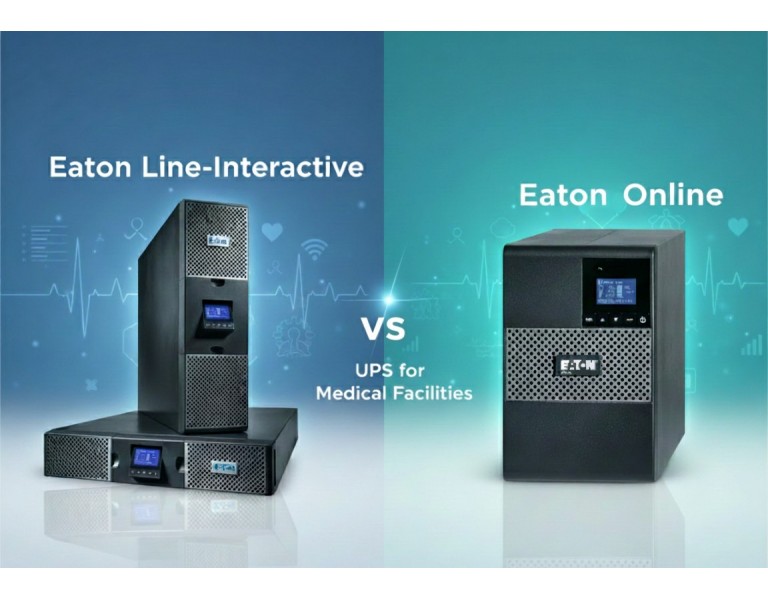
In a clinical environment, unexpected power problems aren’t “an inconvenience” — they can disrupt imaging systems, patient monitoring, surgical theaters, and life-critical IT. You’re tasked with specifying uninterruptible power systems that keep equipment alive, avoid data corruption, and meet safety and regulatory expectations. The big architectural choice is often between line-interactive and online (double conversion) UPS designs. This isn’t marketing hype — it’s about how each topology behaves under real electrical stress: sags, surges, frequency shifts, and complete outages. The goal here is simple: explain how each UPS works, where it fits in a healthcare facility, and how to decide based on load criticality, budget, and compliance needs.
A line-interactive UPS uses an automatic voltage regulator (AVR) and a bidirectional converter. Under small brownouts or overvoltage events, the AVR corrects the power without switching to battery. Only for deeper sags, surges, or outages does the inverter take over. This keeps batteries cycling less often and improves efficiency.
Online UPS always runs the load through the rectifier and inverter, effectively isolating equipment from the raw mains. Input power is continuously conditioned — voltage, frequency, and waveform — so the load sees a stable, regenerated AC output at all times. There’s no transfer time because the inverter is always in the power path.
| Feature / Metric | Eaton Line-Interactive | Eaton Online UPS |
|---|---|---|
| Power Conditioning | Moderate (AVR) | High (continuous double conversion) |
| Transfer Time to Battery | Small transfer | Zero (always on inverter) |
| Voltage Sag/Swell Response | AVR handles minor issues | Full conditioning |
| Ideal Load Type | General IT, low-critical | Critical medical, imaging, lab |
| Frequency Stability | Limited | Tight regulation |
| Noise Isolation | Moderate | Excellent |
| Typical Efficiency @ Load | Higher | Slightly lower |
| Cost | More budget-friendly | Higher initial cost |
| Maintenance Complexity | Lower | Higher |
| Compliance Fit (critical life support) | Limited | Strong |
Pros
Efficient under normal conditions — less battery wear for minor fluctuations.
Lower upfront cost, easier to deploy in auxiliary areas.
Adequate for non-life-critical infrastructure (back-office servers, HVAC controls).
Cons
Not suitable where voltage/frequency isolation is required.
Transfer time, albeit small, exists.
Limited protection against harmonics or severe utility issues.
Pros
Continuous double conversion means load always sees clean power.
Zero transfer time eliminates switchover disturbance.
Best choice where uptime and regulation (e.g., medical protocols) matter.
Cons
Higher purchase and maintenance cost.
Efficiency can be lower at light loads.
More complex service requirements.
Here’s the core decision logic to apply in clinical facilities:
Critical life support, imaging, and diagnostics
These systems must never experience even a transitory power event. The cost impact of a misdiagnosis or procedure interruption outweighs UPS price differences. Choose online UPS.
Non-life-critical IT and facility support
If the load is important but won’t jeopardize patients during a brief brownout, and regulatory isolation isn’t mandated, a line-interactive UPS can be justified economically.
Compliance and safety standards
Many medical safety frameworks emphasize isolation, predictability, and minimal electrical disturbance. Online UPS topologies inherently deliver the tightest regulation.
1. Emergency Department Servers and Monitors
In an ER, even a momentary power glitch can cause monitors to reset or alarms to miss triggers. Online UPS ensures no transfer interruptions and consistent waveform quality, critical for life-sustaining equipment.
2. Imaging Modalities (MRI, CT, Ultrasound)
These systems are sensitive to both voltage distortion and frequency swings. With line-interactive, minor corrective action might be adequate, but for guaranteed waveform purity and maximum uptime, online double conversion is the prudent choice.
3. Administrative and Support Areas
Back-office servers, print servers, and non-clinical workstations benefit from cost-effective line-interactive units because their uptime obligations are lower.
For medical facilities where patient safety, uptime, and electrical isolation matter most, online UPS systems are the stronger architectural choice. They deliver continuous conditioning and zero transfer disturbance. Line-interactive units serve in less critical roles where cost and efficiency matter more than absolute power integrity.
For clinics and hospitals planning their UPS deployment, DC Supplies offers technical consultations and tailored Eaton UPS solutions designed for healthcare environments. Whether you’re protecting a small diagnostic lab or securing an entire data center, they can help align your uptime requirements with compliance standards and budget constraints. Reach out to get expert sizing, redundancy planning, and service support that keeps critical equipment powered and compliant.










Comments (0)
No comment