No products
To be determined Shipping
$0.00 Total

Blog Categories
Archives
Latest Posts


Compare Eaton and HPE UPS systems for data centers to choose the right runtime, redundancy, and monitoring approach for your server room or enterprise environment.
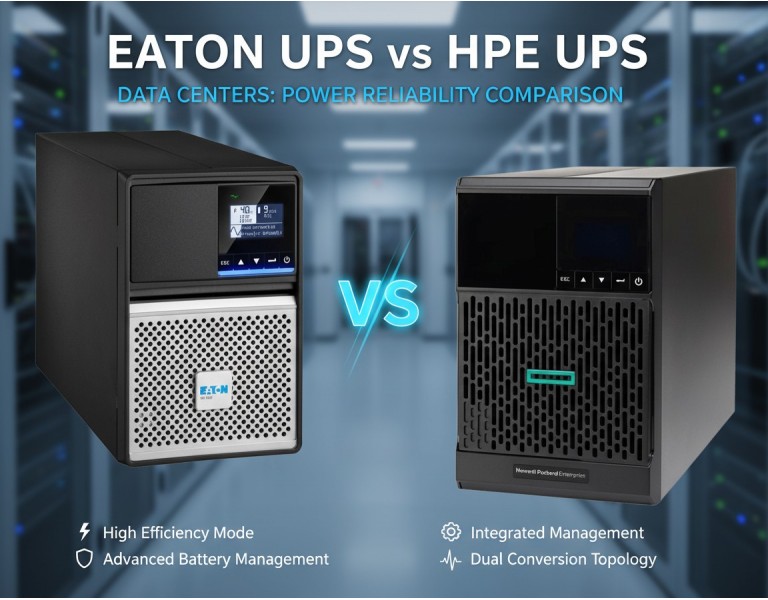
You’re sizing UPS gear for a data center and hit a familiar problem: downtime costs money, but overspending on power infrastructure also hurts the budget. Should you pick Eaton’s long-running, scalable UPS platforms or HPE’s integrated power systems built to fit their server stack? The answer affects how long your equipment runs during an outage, how graceful your shutdowns are, and how easily you manage alerts and redundancy. This post breaks down the strengths and limitations of each vendor’s UPS approach so you can match features to real data-center needs — not hype.
Eaton is known in infrastructure circles for modular, scalable UPS hardware with industry-proven runtime performance, strong diagnostics, and flexible redundancy models. Eaton’s power platforms scale from small server closets to large enterprise racks.
HPE positions integrated power protection that fits tightly with its server blades and rack systems, emphasizing simple management alongside its hardware portfolio. HPE UPS units are often designed for simplicity inside HPE-centric deployments, with management visibility tied into server infrastructure.
| Category | Eaton UPS | HPE UPS |
|---|---|---|
| Performance | High, scalable capacity with modular expansion | Good performance in small–medium racks |
| Reliability | Designed for continuous operation, robust MTBF | Reliable for rack-level redundancy |
| Management | Advanced remote monitoring, detailed logs | Integrated with server system management |
| Power Efficiency | High efficiency across load ranges | Competitive efficiency at rated loads |
| Redundancy Options | N+1, 2N modular configurations | Rack-redundant options at lower tiers |
| Best Use Case | Medium to large data centers | Smaller racks or HPE-centric deployments |
| Target Data Center Size | 20–100+ kW loads | Sub-20 kW racks |
Pros
Scales from small rack to enterprise power footprints without forklift upgrades.
Strong support for modular redundancy (N+1, 2N).
Detailed remote monitoring and diagnostics available.
Proven runtime headroom for extended outages.
Flexible serviceability with hot-swap modules.
Cons
Management interface can require more setup expertise.
Larger modular units need more rack space.
Full capability often shines at scale, less so for tiny closets.
Pros
Seamless management integration with HPE server ecosystems.
Simpler installation for smaller rack deployments.
Compact footprint tailored for specific rack units.
Predictable performance in rated environments.
Cons
Less scalable beyond moderate power footprints.
Redundancy often limited to rack pair rather than full site.
Management features can be less granular outside HPE systems.
Small to Mid-Size Server Rooms (under 20 kW): HPE UPS units often meet the need for straightforward, reliable power with tight integration into HPE server management tools. You get enough runtime for graceful shutdowns and alerting without extra complexity.
Mid to Large Data Centers (20–100+ kW): Eaton’s modular UPS systems give you the flexibility to grow, build runtime with battery strings, and add redundancy in stages. If you expect load growth or need fine-grained failure tolerance (N+1 or 2N), Eaton’s platform better fits long-term resilience.
When runtime matters most: Prioritize Eaton’s modular capacity because extended runtime with maintainable modules matters during lengthy outages.
When simplicity matters: For smaller racks with mostly HPE gear, HPE’s integrated UPS simplifies management and monitoring paths.
40-kW Enterprise Rack Cluster: A data center with mixed virtualization and database workloads needed reliable runtime and graceful failover. Eaton’s modular UPS with N+1 redundancy provided extra battery strings and redundant power paths, reducing outage risk without overspending.
15-kW HPE-Centric Server Room: A regional office with HPE servers and BladeSystems required straightforward power protection. HPE UPS units delivered clean power and integrated monitoring inside the existing management console, reducing the need for separate power tools.
Growing Edge Data Center (30–50 kW planned): A distributed edge facility needed UPS gear that could expand as demand grew. Eaton’s platform allowed incremental capacity additions and redundancy tuning as load increased.
For critical data-center power, Eaton’s UPS solutions offer scalability, modular redundancy, and deep runtime options suited to growing or high-availability environments. HPE’s UPS systems provide reliable, easy-to-manage power protection for smaller racks or shops tightly aligned with HPE server ecosystems. Match your expected load growth, redundancy needs, and management preferences to the platform that fits your operational reality.
If you’re planning UPS upgrades for your data center, DC Supplies can help you right-size both Eaton and HPE UPS systems to your exact runtime and redundancy requirements. We provide detailed load analysis, battery runtime planning, and deployment support tailored to your existing infrastructure. Whether you’re optimizing a small server room or scaling a multi-rack data center, our engineers will ensure your UPS selection aligns with your reliability and budget goals.










Comments (0)
No comment