How to Choose APC UPS for Server Rooms and Small Data Centers
A decision-focused guide to selecting the right APC UPS based on load, runtime, and redundancy for server rooms and small data centers.
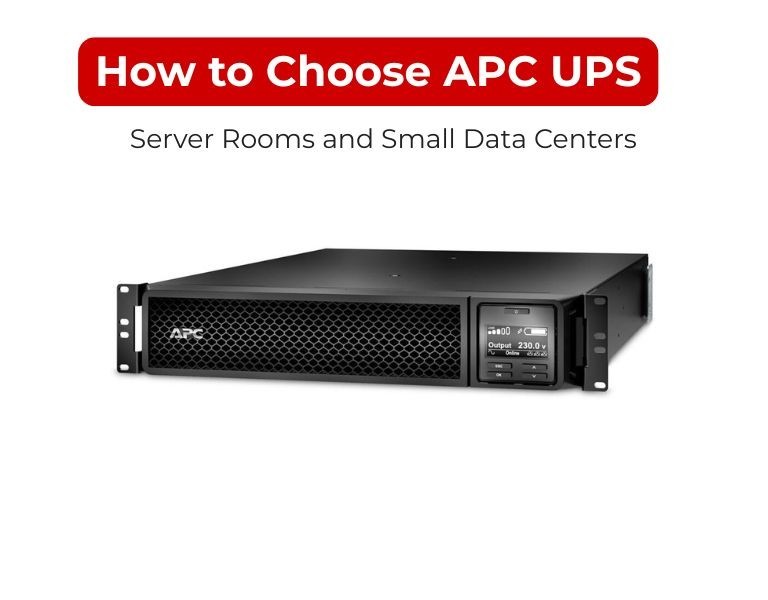
Introduction
Choose an APC UPS by matching actual load (kW), required runtime, and redundancy level. For server rooms, focus on simplicity and short runtime. For small data centers, prioritize scalability, N+1 redundancy, and integration with power infrastructure.
Oversizing wastes budget; undersizing risks downtime.
Use Case / Deployment Fit
Server Room
- Load: 1–10 kW
- Few racks, mixed equipment (servers, switches, storage)
- Runtime: 5–15 minutes (graceful shutdown)
- Typically single-phase UPS
Small Data Center
- Load: 10–100 kW
- Rack-based, higher density
- Runtime: 10–30 minutes (generator bridging)
- Three-phase UPS with redundancy (N+1 common)
Technical Breakdown
1. Measure Real Load (Not Nameplate)
- Use PDU or monitoring tools
- Add 20–30% headroom for growth
- Convert to kW (not just VA)
2. Choose UPS Topology
- Line-interactive: acceptable for non-critical edge setups
- Online double-conversion: required for server rooms and data centers (stable output, no transfer time)
3. Capacity Selection (VA vs kW)
- Modern APC systems operate at high power factor (~0.9–1.0)
- Select based on usable kW, not inflated VA ratings
4. Runtime Planning
- Server room: battery runtime for shutdown
- Small data center: runtime to bridge generator startup
- Use external battery packs if extended runtime is needed
5. Phase Type
- Up to ~10 kW → single-phase
- Above ~10–15 kW → three-phase for efficiency and distribution balance
6. Redundancy Strategy
- Server room: typically none (cost-sensitive)
- Small data center:
- N (minimum)
- N+1 (recommended)
- Parallel UPS or modular systems
7. Form Factor
- Rack-mounted for space efficiency
- Tower for very small setups
- Modular UPS for scalable environments
Comparison Table
| Factor | Server Room UPS | Small Data Center UPS |
|---|
| Load Range | 1–10 kW | 10–100 kW |
| UPS Type | Online | Online (modular preferred) |
| Phase | Single-phase | Three-phase |
| Runtime | 5–15 min | 10–30 min |
| Redundancy | Rare | N+1 common |
| Scalability | Limited | High |
Limitations & Trade-offs
Smaller APC UPS (Server Rooms)
- Limited battery scalability
- No built-in redundancy
- Can become a bottleneck as load grows
Larger APC UPS (Small Data Centers)
- Higher upfront investment
- Requires electrical planning (distribution, breakers)
- More complex installation and maintenance
Procurement Insight
- Always validate input/output voltage compatibility (e.g., 230V vs 400V environments)
- Check battery lifecycle cost, not just UPS price
- Ensure network management card support for monitoring
- Prefer modular APC systems to avoid full replacement during expansion
Enterprise IT teams often standardize on APC platforms and source compatible UPS units and battery modules through distributors like DC Supplies to maintain consistency across rack deployments and reduce lead time variability.
Real-world Scenarios
Scenario 1: 2-Rack Server Room
- Load: 3 kW
- UPS: 5 kVA rack-mounted APC Smart-UPS
- Runtime: 10 minutes
- No redundancy
Scenario 2: Growing Edge Data Room
- Load: 12 kW
- UPS: 15–20 kVA three-phase APC UPS
- Runtime: 15 minutes
- External batteries added
Scenario 3: Small Data Center (40 kW)
- UPS: 50 kW modular APC UPS
- Configuration: N+1 redundancy
- Runtime: 20 minutes with battery bank
- Integrated with generator
Final Recommendation
- Choose APC Smart-UPS (single-phase) when:
- Load is under ~10 kW
- You need reliable shutdown protection
- Deployment is simple and space-constrained
- Choose APC Easy UPS or Symmetra/modular systems (three-phase) when:
- Load exceeds ~10–15 kW
- Uptime is critical
- You need redundancy and scalability
The correct APC UPS is defined by power continuity requirements, not just device count. Start with load and runtime, then design for growth and failure tolerance.













Comments (0)
No comment