No products
To be determined Shipping
$0.00 Total

Blog Categories
Archives
Latest Posts

Explore how NVIDIA Vera Rubin is reshaping data center power, UPS design, cooling, and infrastructure for high-density AI racks.
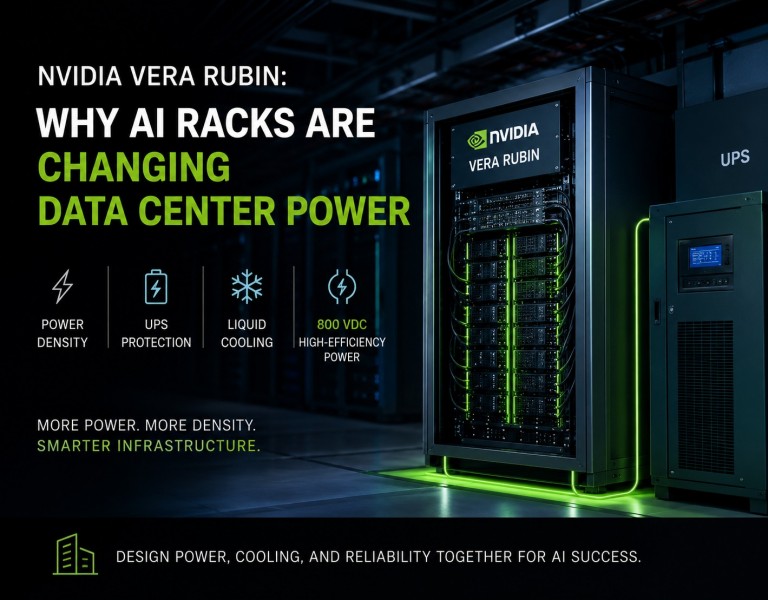
Artificial intelligence is changing more than the servers inside a data center. It is changing how the entire facility has to be designed around power, cooling, networking, and reliability.
NVIDIA's Vera Rubin platform is a good example of this shift.
NVIDIA describes Vera Rubin as a rack-scale AI platform rather than simply another generation of GPUs. The Vera Rubin NVL72 combines 72 Rubin GPUs, 36 Vera CPUs, networking hardware, NVLink 6 switches, and other components into a tightly integrated rack-scale system. NVIDIA says the platform is now in full production and is expected to begin shipping at scale during 2026.
For data center operators, however, the interesting question isn't only how fast Vera Rubin can run AI workloads.
It is:
What does this kind of infrastructure mean for the power systems protecting it?
Traditional server deployments often allow organizations to think about computing capacity one server at a time.
Rack-scale AI systems change that model.
The compute, networking, power delivery, and cooling infrastructure are increasingly designed together. NVIDIA's own technical material describes Vera Rubin as part of an AI-factory architecture in which power, cooling, networking, and compute have to operate as an integrated system.
That has an important consequence for data center managers:
Adding AI capacity can require much more than installing new servers.
Electrical distribution, UPS capacity, cooling infrastructure, rack design, monitoring, and redundancy may all need to be evaluated before deployment.
One of the biggest challenges is power density.
A rack containing a large number of high-performance accelerators can place substantially different demands on a facility than conventional enterprise server racks.
The Vera Rubin NVL72 is designed as a rack-scale system containing 72 GPUs and 36 CPUs, alongside networking and switching components.
This means infrastructure teams have to think beyond the total electrical capacity of a data center.
They also have to ask:
How much power can each rack receive?
Can the existing distribution system support the load?
Is the UPS sized for the actual rack configuration?
How much headroom remains for future expansion?
Can the generator and UPS systems operate together correctly?
What happens to the facility if a rack suddenly loses utility power?
These questions become increasingly important as AI infrastructure becomes denser.
A UPS is not simply a large battery connected between the utility and a server.
In a high-density AI environment, the UPS becomes part of a larger electrical resilience strategy.
Its job can include protecting critical computing equipment from:
Utility interruptions
Voltage disturbances
Electrical noise
Short-duration outages
Transfer events
Generator-startup interruptions
For conventional server deployments, UPS capacity can sometimes be estimated primarily from the expected IT load.
High-density AI deployments require a more detailed analysis.
The facility operator needs to understand the expected load profile, redundancy requirements, distribution architecture, runtime requirements, and the interaction between the UPS and the rest of the electrical infrastructure.
Simply selecting a UPS based on the nameplate rating of the equipment may not be enough.
High-performance computing infrastructure is highly dependent on stable electrical power.
A data center may have enough total generating capacity and still have problems if the distribution architecture is not designed correctly.
This is why infrastructure teams should consider:
Capacity
Can the electrical system deliver the required power?
Redundancy
What happens if one UPS module, power path, or distribution component fails?
Power quality
Can the system maintain acceptable voltage and frequency during disturbances?
Runtime
How long does the UPS need to support the load before another power source becomes available?
Scalability
Can additional AI racks be added without redesigning the electrical infrastructure?
These questions are becoming more important as AI deployments move toward larger rack-scale systems.
Power and cooling can no longer be treated as completely separate infrastructure problems.
More electrical power consumed by computing equipment ultimately becomes heat that has to be removed.
NVIDIA says the Rubin generation is designed around 100% liquid cooling, with direct-to-chip cooling extending across the compute and networking components.
NVIDIA has also highlighted a 45°C liquid-cooling inlet design intended to enable chiller-free dry-cooler operation in appropriate facilities.
This represents a major shift from traditional air-cooled server rooms.
Instead of simply increasing the capacity of room-level air conditioning, future AI facilities may require:
Coolant distribution units
Direct-to-chip cooling
Facility water loops
Higher-capacity heat rejection
New monitoring systems
Different rack plumbing arrangements
That means the electrical and cooling designs have to be considered together.
Another development worth watching is the move toward higher-voltage DC architectures for AI infrastructure.
NVIDIA has presented 800 VDC power distribution as an architecture for high-density AI and HPC workloads, with the goal of reducing conversion losses and supporting scalable high-power deployments.
This doesn't mean every existing data center will immediately replace its electrical architecture with 800 VDC.
It does, however, show the direction the industry is moving toward.
As rack power requirements increase, conventional power-delivery approaches face increasing pressure from conversion losses, conductor requirements, distribution efficiency, and physical constraints.
For infrastructure managers, this means the power architecture supporting AI systems may look very different from the architecture used for today's conventional server racks.
Organizations planning to deploy high-density AI infrastructure should evaluate the facility before purchasing the hardware.
A useful checklist includes:
Determine the actual available capacity at the facility and at the intended rack locations.
Review UPS capacity, redundancy, runtime, bypass arrangements, battery systems, and future expansion requirements.
Evaluate PDUs, busways, branch circuits, cabling, breakers, and distribution paths.
Determine whether existing air cooling is sufficient or whether liquid cooling infrastructure is required.
Verify that standby generation and UPS systems can work together under the expected load.
High-density deployments require better visibility into power, temperature, cooling, and equipment status.
Avoid designing a facility around today's AI rack requirements if the goal is to support several generations of accelerated computing.
The most important lesson from Vera Rubin may not be the specifications of any individual GPU or CPU.
It is the fact that AI computing is increasingly being designed at the rack and facility level.
NVIDIA's DSX platform, for example, is designed to coordinate compute, power, cooling, and operations as part of AI-factory infrastructure.
That is a significant change in how IT infrastructure is planned.
The old model was often:
Buy servers → install servers → connect power → cool the room.
The emerging model is closer to:
Design compute + power + cooling + networking + facility infrastructure together.
For data center managers, Vera Rubin is therefore more than another hardware release.
It is an indication of where infrastructure requirements are heading.
Higher-density AI systems are forcing organizations to reconsider electrical capacity, UPS design, cooling architecture, power distribution, and facility scalability.
The organizations that plan these requirements early will have a much easier path to deploying future AI infrastructure than those that discover electrical or cooling limitations after the hardware has already been purchased.
As rack-scale AI systems become more common, power and cooling are becoming just as important to the deployment conversation as compute performance itself.
That is perhaps the biggest infrastructure lesson behind NVIDIA Vera Rubin.
NVIDIA — Vera Rubin Platform
NVIDIA — Inside the NVIDIA Rubin Platform
NVIDIA — Vera Rubin Full Production Announcement
NVIDIA — Liquid Cooling for AI Factories
NVIDIA — 800 VDC and Modular Data Center Solutions










Comments (0)
No comment