No products
To be determined Shipping
$0.00 Total

Blog Categories
Archives
Latest Posts

A practical guide to understanding HPE stackable switches and when your business should deploy them for scalability, uptime, and network simplicity.

As your business grows, so does your network. What started as a single switch in a small office eventually becomes a mix of access points, VoIP phones, IP cameras, servers, and wired users all competing for bandwidth. The problem is that adding more standalone switches increases complexity, makes management harder, and can introduce bottlenecks.
That’s where HPE stackable switches come in. They let you combine multiple switches into a single logical unit, simplifying configuration and providing redundancy without jumping into costly chassis systems. This guide breaks down how stackable switching works, when you should use it, and how to design the right architecture for your environment.
HPE stackable switches allow multiple switches to be interconnected and managed as one device. Instead of configuring each switch separately, you get a unified control plane. They share bandwidth, routing tables, and even failover capabilities.
For growing businesses, this offers a bridge between simple unmanaged switching and expensive modular chassis systems.
Multiple switches behave like a single device, making VLANs, QoS, and routing easier to configure.
Need more ports? Add another switch to the stack without changing the existing design.
If one switch in the stack fails, traffic automatically reroutes through remaining units.
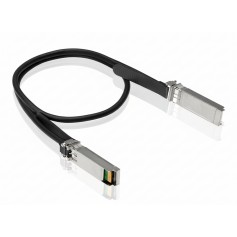
Stack cables create high-bandwidth links—ideal for environments that require stable throughput.
You get modular-style growth without buying a full chassis solution.
If your user count is increasing and you expect more devices per user (laptops, phones, VoIP, APs), stackable switches let you scale ports while keeping management simple.
Architecture Example:
Two access switches for end users
One core switch
All three stacked for easier management
Instead of deploying independent switches per floor, stack them to maintain consistent policy and centralized control.
Why it matters:
Unified VLANs, centralized routing, and shared redundancy across floors.
If downtime impacts revenue—call centers, retail POS, clinics—stackable switches give seamless failover.
Benefit:
A failed unit doesn’t bring the whole network down.
Stacking ensures high-throughput inter-switch links and avoids bottlenecks.
Where this fits:
Design studios, engineering firms, local file-sharing environments.
If you're not ready for a full core switch setup, stackable L3 switches form a cost-effective, highly scalable foundation.
Future-proofing:
Start with 2 switches, expand to 4–8 as the office grows.
(All verified models commonly used in SMB and mid-market deployments)
Ideal for access layers, PoE-heavy environments, and growing offices.
Designed for high-performance networks with Layer 3 capabilities.
For large networks needing advanced routing and campus-scale performance.
Basic stacking capability for budget-conscious deployments.
Easy centralized management
Redundant design increases uptime
Scales without redesigning the network
High-bandwidth stacking links
Lower cost vs. chassis systems
More expensive than standalone switches
Requires proper stacking cables/modules
Limited stacking size depending on model
Bandwidth shared across stack backplane
Use two stackable switches:
One handling core + access
One for expansion or PoE devices
Three–four switch stack:
Two access switches
One PoE/voice switch
One core switch
Use Layer 3-enabled stackable switches with dual power supplies and high-bandwidth uplinks.
Needs fast access to shared media files and reliable Wi-Fi. Stacking two switches prevents bottlenecks and centralizes management.
VoIP requires uptime. A four-switch stack with redundant uplinks ensures no call drops during maintenance or failures.
Multiple floors, many users, unified network policies—stacking ensures consistent VLANs and easy control.
HPE stackable switches are ideal for businesses needing a scalable, reliable, and easy-to-manage network infrastructure without the cost of a full modular chassis. If your business is growing, deploying multiple switches, managing several VLANs, or prioritizing uptime, stacking is an efficient and future-proof architecture.
Upgrade your network with HPE stackable switches from DC Supplies. Whether your business needs scalable access switching, high availability, or simplified network management, we provide reliable, enterprise-ready HPE solutions that grow with your needs. Get expert guidance, fast delivery, and the right hardware to build a future-proof network for your expanding business.










Comments (0)
No comment