HPE Aruba Switches Review: Which Series Is Best for Your Network?
Aruba switch series explained for SMB, campus, and data center
Introduction
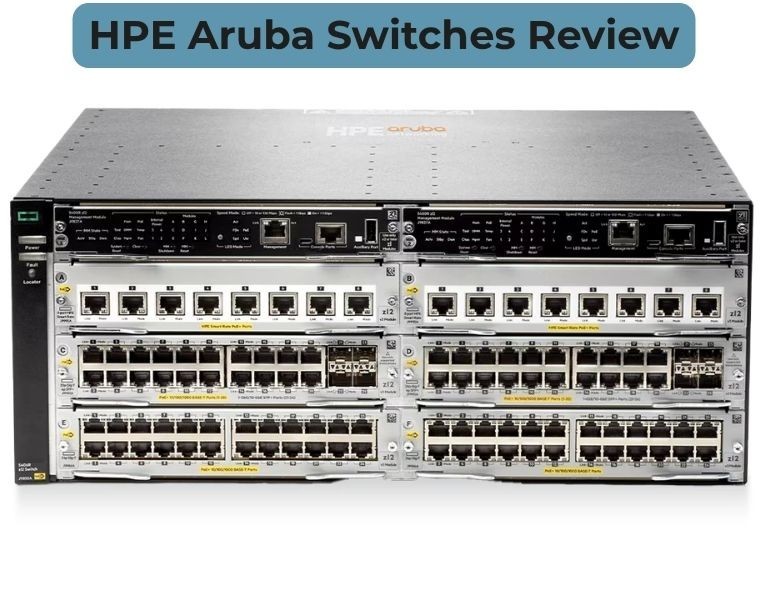
If you're selecting HPE Aruba switches for a real deployment, the decision is not about features—it’s about choosing the right series for your network layer. CX series is the current platform for enterprise and future deployments, while older 2530/2540/2930 models still exist in cost-sensitive environments. The key factors are operating system (AOS-CX vs legacy), required Layer 3 capabilities, PoE budget, and scalability. Choosing the wrong series usually results in upgrade limitations or unnecessary spend.
Which series should you choose?
Use HPE Aruba CX for any new deployment.
Use legacy 2530/2540/2930 only if you’re maintaining or extending an existing network.
Technical Breakdown
Aruba CX Series (6000, 6100, 6200, 6300, 6400)
- Runs AOS-CX (modern, database-driven OS)
- Supports automation, APIs, and non-disruptive upgrades
- Scales from SMB access to data center core
- VSF/VSX stacking for redundancy and expansion
Where it fits:
- CX 6000/6100 → SMB & branch access
- CX 6200 → enterprise access (replacing 2930F)
- CX 6300/6400 → aggregation and campus core
- CX 9300/10000 → data center
Reality in deployment:
- Consistent OS across layers simplifies operations
- Better for long-term lifecycle and support
- Required for Wi-Fi 6/6E/7 environments
Aruba 2930 Series (2930F / 2930M)
- Legacy ArubaOS-Switch platform
- Layer 3 capable with stacking (VSF)
- Good PoE capacity for campus deployments
Where it fits:
- Existing enterprise networks
- Mid-size campus access
Limitations:
- Being phased out in favor of CX
- Less automation and modern tooling
Aruba 2540 Series
- Lite Layer 3 (static/RIP)
- 10G uplinks available
- No stacking support
Where it fits:
- Office access layer
- Cost-sensitive deployments
Limitations:
- Legacy OS (AOS-S)
- Limited scalability
Aruba 2530 Series
- Layer 2 only
- Basic managed switch
- Low cost, reliable
Where it fits:
- Small offices
- Simple access networks
Limitations:
- No Layer 3
- End-of-life direction
- Not suitable for modern enterprise needs
Comparison Table
| Feature | CX Series | 2930 Series | 2540 Series | 2530 Series |
|---|
| Performance | High, scalable | Medium-high | Medium | Basic |
| Reliability | Enterprise-grade | Proven | Stable | Stable |
| Management | AOS-CX (modern) | Legacy CLI | Legacy CLI/API | Basic CLI |
| Scalability | High (VSF/VSX) | Medium (VSF) | Low | Low |
| Power / Efficiency | Optimized PoE | High PoE | Standard PoE | Standard |
| Warranty | Limited lifetime | Limited lifetime | Limited lifetime | Limited lifetime |
| Price Range | $$$ | $$ | $$ | $ |
| Best Use Case | Enterprise / DC | Campus access | Office access | SMB basic |
| Business Size | SMB → Enterprise | Mid → Enterprise | SMB → Mid | Small business |
Pros and Cons
CX Series
Pros
- Future-proof platform
- Automation and API support
- Unified OS across all layers
Cons
- Higher upfront cost
- Learning curve for teams used to legacy ArubaOS
2930 Series
Pros
- Strong Layer 3 access features
- Reliable for campus networks
Cons
- Legacy platform
- Limited future support
2540 Series
Pros
- Cost-effective
- 10G uplinks for access layer
Cons
- No stacking
- Limited scalability
2530 Series
Pros
- Low cost
- Simple deployment
Cons
- No Layer 3
- Not suitable for modern workloads
Procurement Insight
- Buy CX if you’re deploying new infrastructure—this avoids forced upgrades in 2–3 years.
- 2930 still makes sense only if you already run ArubaOS-based networks and want consistency.
- 2540/2530 are only justified when budget is tight and requirements are basic.
- For long-term ROI, CX reduces operational overhead due to automation and unified OS.
If you're sourcing Aruba switches in the US, suppliers like DC Supplies typically maintain inventory across both legacy and CX series, which helps when mixing old and new environments.
Real-World Use Cases
Office (25–50 users)
- CX 6000 or 6100
- Enough PoE for APs, phones, cameras
Multi-branch business
- CX 6100 at edge + CX 6200 aggregation
- Centralized management via Aruba Central
Data center / rack deployment
- CX 6300 or 6400
- High throughput with redundancy (VSX)
Final Recommendation
Choose CX series if you're building or upgrading any serious network.
Choose 2930 only for existing environments that require compatibility.
Avoid 2530/2540 for new deployments unless budget is the only concern.













Comments (0)
No comment