No products
To be determined Shipping
$0.00 Total

Blog Categories
Archives
Latest Posts

A practical guide comparing Eaton rackmount and tower UPS systems to help businesses choose the right form factor for reliability, space, and scalability.
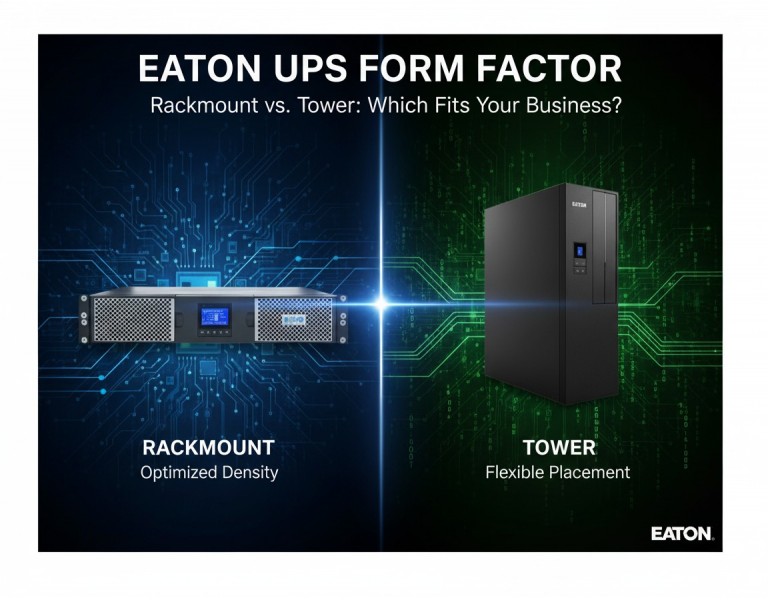
Choosing the right UPS is more than just picking a power rating. You might be wondering if a tower UPS or a rackmount UPS is better for your server room. Form factor affects installation flexibility, maintenance, cooling, and expansion. For IT teams and procurement managers, making the wrong choice can complicate future upgrades or waste valuable space. This guide explains both options so you can select the UPS that fits your business needs, layout, and growth plans.
Eaton is known for reliable, efficient power management solutions. Their UPS systems serve small offices, mid-size data centers, and enterprise environments, offering both tower and rackmount designs that meet strict uptime and redundancy standards.
| Feature | Eaton Rackmount UPS | Eaton Tower UPS |
|---|---|---|
| Performance | High-density, ideal for racks | Flexible placement, moderate load |
| Reliability | N+1 redundancy options | Single or dual battery packs |
| Management | Network management card, remote monitoring | Local LCD panel, optional network card |
| Power Efficiency | Optimized for 19” racks | Standard efficiency, easy airflow |
| Warranty & Support | 3–5 years limited, service options | 3–5 years limited, service options |
| Price Range | $1,200–$3,000 | $800–$2,500 |
| Best Use Case | Data center racks, dense server setups | Offices, single-server rooms, labs |
| Target Business Size | Medium to large enterprises | Small to mid-size businesses |
Eaton Rackmount UPS
Pros: Space-saving in racks, high scalability, better cooling, remote management
Cons: Requires rack installation, more complex maintenance, higher upfront cost
Eaton Tower UPS
Pros: Flexible placement, easy setup, quieter operation, lower initial cost
Cons: Takes floor space, limited high-density scaling, fewer redundant options
For businesses with a dedicated server rack, rackmount UPS provides space efficiency, advanced monitoring, and better integration with redundant systems. Tower UPS works well for offices or labs where rack space is limited, load is moderate, and installation simplicity matters more than scalability.
Small Office (15–20 users): Tower UPS under a desk powering servers and switches.
Medium Data Center (50–100 servers): Rackmount UPS for dense racks, remote monitoring, and redundancy.
Branch Office (remote site): Tower UPS for network closet and minimal IT staff.
Your choice between Eaton rackmount and tower UPS should focus on installation space, future growth, and monitoring needs. Rackmount suits dense server environments, while tower is perfect for offices needing easy deployment and moderate capacity.
Looking for the perfect UPS solution for your business? DC Supplies offers a full range of Eaton rackmount and tower UPS systems with verified specifications, expert guidance, and competitive pricing to ensure your servers and critical devices stay protected. Contact DC Supplies today to find the right UPS that fits your office or data center requirements, optimize uptime, and simplify your power management strategy.










Comments (0)
No comment